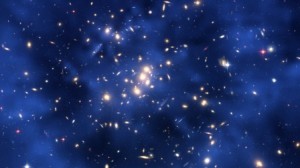
LONDON: Dark matter reveals itself in the way its gravity affects stars and galaxies, but has never been directly observed.
A completely new type of fundamental particle may explain the mystery of “dark matter”, the missing material that makes up more than 80 per cent of the universe’s mass, British scientists believe.


University of Southampton researchers believe one reason may be that dark matter particles are much lighter than has previously been proposed, with the mass of only 0.02 per cent of an electron. Their findings are published in the journal Scientific Reports.
Dr James Bateman said: “Our candidate particle sounds crazy, but currently there seem to be no experiments or observations which could rule it out.”
But despite extensive efforts the mysterious material has never been directly observed.
The new research suggests one reason for this may be that dark matter particles are much lighter than has previously been proposed.
The hypothetical particle has a mass only about 0.02 per cent that of an electron. While it does not interact with light, it interacts surprisingly strongly with normal matter, and may not even be able to penetrate the Earth’s atmosphere.
If this is the case, dark matter particles are unlikely to be spotted by Earth-bound detectors.
Dr James Bateman, from the department of physics and astronomy at the University of Southampton, said: “This work brings together some very different areas of physics: theoretical particle physics, observational X-ray astronomy, and experimental quantum optics.
“Our candidate particle sounds crazy, but currently there seem to be no experiments or observations which could rule it out. Dark matter is one of the most important unsolved problems in modern physics, and we hope that our suggestion will inspire others to develop detailed particle theory and even experimental tests.”
The team, whose findings are published in the journal Scientific Reports, hope to incorporate a search for the new particle into a space experiment with which it is already involved.