Customs Today
  • Home
  • Islamabad
  • Karachi
  • Lahore
  • National
  • Transfers and Postings
  • Chambers & Associations
  • Business
No Result
View All Result
Customs Today
  • Home
  • Islamabad
  • Karachi
  • Lahore
  • National
  • Transfers and Postings
  • Chambers & Associations
  • Business
No Result
View All Result
Customs Today
No Result
View All Result
Home Science & Technology Science

Amazing formation flying skills of migrating birds share hardship of being leader

byCustoms Today Report
04/02/2015
in Science, Science & Technology
Share on FacebookShare on Twitter

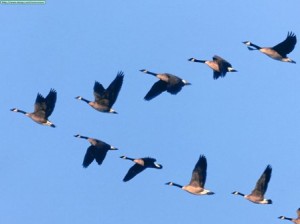
HONG KONG: Amazing formation flying skills of migrating birds unraveled: ‘V’shape and timing of flaps ensures flock is aerodynamic.

Being the leader in a V-formation of migrating birds is hard work, which is why birds in the formation “share the pain” inherent in that role by taking turns, researchers have found.


You might also like

Tesla driverless system to use updated radar technology

12/09/2016

Apple to develop its own self-driving technology

10/09/2016

After a period of leading the flock, the lead bird can save energy by turning the job over to another bird and then moving back in the formation to follow in the wake of another bird, international researchers led by scientists at Oxford University in England have discovered.

The findings are the first conclusive evidence for “turn taking” reciprocal cooperative behavior in birds, the scientists report in the Proceedings of the National Academy of Sciences.

The researchers followed a flock of juvenile Northern bald ibis birds as they migrated from Austria to Italy.

The birds had been raised to be “human imprinted” so they would follow their handlers flying in powered parachutes, with each bird carrying a tiny data logger that allowed researchers to track the position of individual birds within the V-formation.

Individual birds were seen changing position frequently within the flock, they said, dividing their time between leading the formation and taking advantage of the updraft provided by the flapping of another bird’s wings, where they can save an estimated 10 to 14 percent of their energy output.

“Our study shows that the ‘building blocks’ of reciprocal cooperative behavior can be very simple: ibis often travel in pairs, with one bird leading and a ‘wingman’ benefiting by following in the leader’s updraft,” says lead author Bernhard Voelkl of Oxford’s Department of Zoology.


Related Stories

Tesla driverless system to use updated radar technology

byCT Report
12/09/2016

WASHINGTON: Electric carmaker Tesla announced Sunday it was upgrading its Autopilot software to use more advanced radar technology. In a...

Apple to develop its own self-driving technology

byCT Report
10/09/2016

SAN FRANCISCO: Apple may not become an automaker, but it still wants to develop its own self-driving technology. The iPhone-maker's...

NASA spots slowest known magnetar

byCT Report
10/09/2016

WASHINGTON: Astronomers have found evidence of a magnetar - magnetised neutron star - that spins much slower than the slowest...

‘YouTubers’ outshining old-school television

byCT Report
09/08/2016

SAN FRANCISCO: A media revolution is taking place, and most people over 35 years of age aren’t tuned in. Millennial...

Next Post

HTC Desire 820 Dual Sims available in India at Rs. 21500

  • Terms and Conditions
  • Disclaimer

© 2011 Customs Today -World's first newspaper on customs. Customs Today.

No Result
View All Result
  • Transfers and Postings
  • Latest News
  • Karachi
  • Islamabad
  • Lahore
  • National
  • Chambers & Associations
  • Business
  • About Us

© 2011 Customs Today -World's first newspaper on customs. Customs Today.