WASHINGTON: The new research, led by PhD student Tim Bovaird and Associate Professor Charley Lineweaver from The Australian National University (ANU), made the finding by applying a 200 year old idea to the thousands of exo-planets discovered by NASA’s Kepler space telescope.
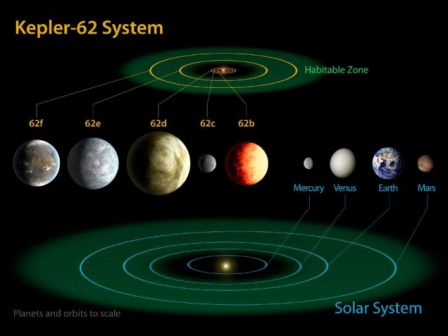
They found the standard star has about two planets in the so-called goldilocks zone, the distance from the star where liquid water, crucial for life, can exist.


“The ingredients for life are plentiful, and we now know that habitable environments are plentiful,” said Lineweaver, from the ANU Research School of Astronomy and Astrophysics.
“However, the universe is not teeming with aliens with human-like intelligence that can build radio telescopes and space ships. Otherwise we would have seen or heard from them.
“It could be that there is some other bottleneck for the emergence of life that we haven’t worked out yet. Or intelligent civilisations evolve, but then self-destruct,” said Lineweaver.
The Kepler space telescope is biased towards seeing planets very close to their stars, that are too hot for liquid water, but the team extrapolated from Kepler’s results using the theory that was used to predict the existence of Uranus.