Customs Today
  • Home
  • Islamabad
  • Karachi
  • Lahore
  • National
  • Transfers and Postings
  • Chambers & Associations
  • Business
No Result
View All Result
Customs Today
  • Home
  • Islamabad
  • Karachi
  • Lahore
  • National
  • Transfers and Postings
  • Chambers & Associations
  • Business
No Result
View All Result
Customs Today
No Result
View All Result
Home Science & Technology Science

First stars in Universe formed 100m yrs later than thought, Planck telescope indicates

byCustoms Today Report
09/02/2015
in Science, Science & Technology
Share on FacebookShare on Twitter

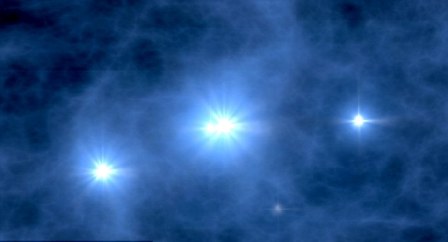
NEW YORK: The first stars twinkled into life some 100m years later than was previously thought, research suggests.

Data from the European Space Agency’s Planck telescope indicates that star formation began about 550m years after the big bang that gave birth to the universe.


You might also like

Tesla driverless system to use updated radar technology

12/09/2016

Apple to develop its own self-driving technology

10/09/2016

Before that time, described as the “reionisation” epoch, the cosmos occupied a dark age devoid of visible light.

The big bang 13.8bn years ago was when matter, space and even time exploded into existence. Previously scientists had thought that the first stars began to shine 440m years after the big bang. The new results, still to be confirmed by further measurements, suggest that they are 100m years younger.

Planck, launched in 2009, was designed to study the “cosmic microwave background” – the faint radiation echo left by the big bang – with unprecedented accuracy. It was decommissioned in 2013 after exhausting its supply of liquid helium coolant.

Senior scientist Dr Carlo Baccigalupi, from the International School of Advanced Studies in Trieste, Italy, said: “According to Planck’s observations, stars may be younger than believed, in bearing with other independent astrophysical indicators, and this finding may have major consequences on our attempts to understand the dark components of the universe.”

The “dark components” consist of invisible dark matter and dark energy, both of which are still unsolved mysteries whose natures are unknown.

The scientists, who report their findings in the journal Astronomy and Astrophysics, said more Planck data was still to be analysed, which should provide a clearer picture of the evidence.

Reionisation refers to the way energetic ultraviolet light from the first stars splits hydrogen atoms into their component protons and electrons.


Related Stories

Tesla driverless system to use updated radar technology

byCT Report
12/09/2016

WASHINGTON: Electric carmaker Tesla announced Sunday it was upgrading its Autopilot software to use more advanced radar technology. In a...

Apple to develop its own self-driving technology

byCT Report
10/09/2016

SAN FRANCISCO: Apple may not become an automaker, but it still wants to develop its own self-driving technology. The iPhone-maker's...

NASA spots slowest known magnetar

byCT Report
10/09/2016

WASHINGTON: Astronomers have found evidence of a magnetar - magnetised neutron star - that spins much slower than the slowest...

‘YouTubers’ outshining old-school television

byCT Report
09/08/2016

SAN FRANCISCO: A media revolution is taking place, and most people over 35 years of age aren’t tuned in. Millennial...

Next Post

Pakistan hails WB’s approval to 5 projects of 10,000MW

  • Terms and Conditions
  • Disclaimer

© 2011 Customs Today -World's first newspaper on customs. Customs Today.

No Result
View All Result
  • Transfers and Postings
  • Latest News
  • Karachi
  • Islamabad
  • Lahore
  • National
  • Chambers & Associations
  • Business
  • About Us

© 2011 Customs Today -World's first newspaper on customs. Customs Today.