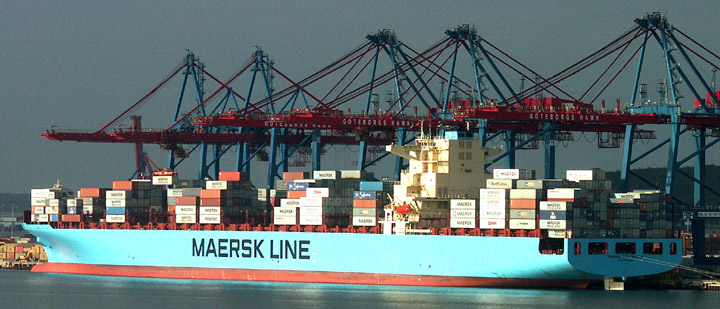
COPENHAGEN: The world’s biggest container-shipping company in terms of capacity which is Denmark’s Maersk Lines is said to be in talks with Asian shipbuilders about the order of up to 10 container mega ships worth around $1.5 billion.
A spokesman for Maersk Line, a unit of conglomerate A.P. Møller-Mærsk A/S, declined to comment. Container shipping, which carries about 95% of the world’s manufactured goods, has suffered for the past decade from overcapacity that has led to falling freight rates, which major operators have described as unsustainable. Dozens of smaller operators regularly undercut freight rates from Asia to Europe and across the Atlantic and Pacific oceans, hoping to stay in business until the industry recovers.


Despite the extra tonnage in the water, Maersk Line Chief Executive Soren Skou told The Wall Street Journal in November that the Danish giant was looking to place new orders of mostly large container ships in the first half of this year.
Mr. Skou said demand for shipping would grow 4% to 5% over the next few years and large container vessels like the Triple-E class—the world’s largest and most efficient vessels, which can carry in excess of 18,000 containers—save the company around 25% of the cost of moving a container from Asia to Europe compared with smaller vessels in Maersk’s fleet, provided the ships sail fully loaded.
Maersk Line ordered 20 such ships in 2011 at a cost of around $185 million per vessel. At the time, competitors doubted whether it would be able to fill such behemoths, but they now are rushing to place their own Triple-E orders to compete with the industry’s big players.
Jonathan Roach, a container-shipping analyst at London-based Braemar ACM Shipbroking, said the new ships would be deployed in the Asia-Europe trade loop, the world’s busiest, and would fit well in the so-called 2M alliance that Maersk Line announced last year with Swiss-based Mediterranean Shipping Co., the world’s second-biggest container operator. The partners will move 35% of all cargo moved between Asia and Europe and also control a market share of 15% and 37% of goods moved on the trans-Pacific and trans-Atlantic routes, respectively.
“As ship prices may go up in the latter part of the year, it’s good to place the orders early,” Mr. Roach said. “The new ships will replace smaller ones which will be cascaded to less-busy routes and put the pressure on smaller operators that can’t match the 2M’s capacity, port calls and fuel efficiency.”
He said global container-fleet capacity would increase by 8% this year, but deliveries of bigger ships that can carry at least 10,000 containers would grow by 25%.
“Everyone looks at bigger vessels and for those that can’t afford them it will be difficult to compete,” Mr. Roach said.
In September, French shipping giant CMA CGM SA formed its own alliance with China Shipping Container Lines Co. and Middle East shipping major United Arab Shipping Co. called Ocean Three, whose fleet will include 11 Triple-Es and control a 20% slice of all cargo between Asia and Europe and 13% and 7% across the Pacific and Atlantic oceans, respectively.