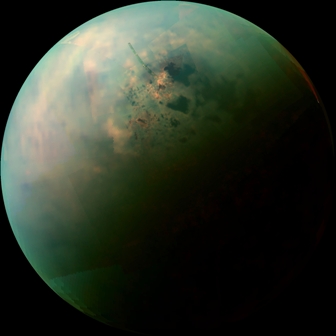


NEW YORK: Titan is by far Saturn’s largest moon and the second-largest satellite in the solar system. It’s also the only world besides Earth where liquids have been found in large amounts on the surface, in the form of lakes and streams of methane and ethane.
This makes Titan an intriguing subject of study for planetary scientists, but unfortunately it’s not all that easy to get a good look at its surface because of its thick orange clouds and dense atmosphere.
Even NASA’s Cassini spacecraft, on location in orbit around Saturn since 2004, can only get tantalizing hints of Titan’s intriguing surface details through cloud-piercing infrared and radar imaging methods, neither of which are anything like what our eyes can perceive. Cassini’s Synthetic Aperture Radar (SAR) imager, in particular, is excellent for obtaining surface maps by bouncing radar waves through the moon’s clouds as if they weren’t even there — but the results, while detailed, are inherently grainy and potentially misleading regarding fine details.
Now, researchers have developed a method to smooth out Cassini’s radar images, giving scientists a new way to look at Titan’s alien — yet surprisingly Earth-like — surface.
The image above shows a section of Ligeia Mare, the second-largest liquid hydrocarbon lake on Titan. The lake’s surface is extremely smooth and uniform, resulting in a dark appearance on radar while the surrounding shoreline and landscape is much rougher and less uniform, showing up as varying shades of greys.

Pakistan to get $3b loan from Islamic Trade Financing Corporation
ISLAMABAD: Islamic Trade Financing Corporation (ITFC) to provide Pakistan with a $3 billion loan, according to an official statement released...