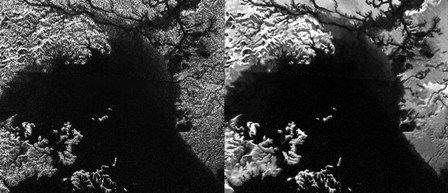
NEW YORK: According to a NASA statement, a new photo processing algorithm has produced the clearest views yet of the surface of Saturn’s moon Titan. The Synthetic Aperture Radar instrument on NASA’s Cassini probe has provided remarkable images of Titan’s surface, penetrating the moon’s extremely thick atmosphere; so far, nearly half of Titan’s surface has been mapped.
However, the radar images have a grainy appearance that renders small-scale features difficult to interpret and changes in an area imaged at different times harder to detect. However, a new technique, termed “despeckling”, has now been employed to clean up the radar images from Cassini.


Despeckling originated with Antoine Lucas, who first thought of using the method as a postdoctoral worker part of the Cassini radar team at the California Institute of Technology and is now in the astrophysics division at CEA, France’s nuclear center. Lucas decided to comb the literature published by researchers working on mathematical algorithms for diminishing noise in images, and connected with a team based near Paris. Lucas and the team worked together to apply their method to Cassini’s images.
Although successful, despeckling requires a large amount of computing power. Also, each image must be manipulated to tease out the best results. For now, the Cassini radar team will have to carefully choose the most intriguing images for despeckling. Despite the limitations, despeckling already has been used to create improved 3-D digital elevation maps of Titan’s surface, allowing scientists to glean more information about river channels, lake shorelines, dunes, and other processes at work on the moon’s surface. The noise itself might provide new data about conditions on Titan’s surface and subsurface.
“This is an amazing technique, and Antoine has done a great job of showing that we can trust it not to put features into the images that aren’t really there,” said Randy Kirk, a radar team member from the U.S. Geologic Survey in Flagstaff, Arizona.