

Customs Today
  • Home
  • Islamabad
  • Karachi
  • Lahore
  • National
  • Transfers and Postings
  • Chambers & Associations
  • Business
No Result
View All Result
Customs Today
  • Home
  • Islamabad
  • Karachi
  • Lahore
  • National
  • Transfers and Postings
  • Chambers & Associations
  • Business
No Result
View All Result
Customs Today
No Result
View All Result
Home Science & Technology Science

Saturn’s largest moon: An amazing new method to look at Titan

byCustoms Today Report
16/02/2015
in Science, Science & Technology
Share on FacebookShare on Twitter

You might also like

Tesla driverless system to use updated radar technology

12/09/2016

Apple to develop its own self-driving technology

10/09/2016

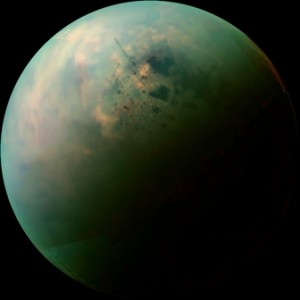
NEW YORK: Titan is by far Saturn’s largest moon and the second-largest satellite in the solar system. It’s also the only world besides Earth where liquids have been found in large amounts on the surface, in the form of lakes and streams of methane and ethane.
This makes Titan an intriguing subject of study for planetary scientists, but unfortunately it’s not all that easy to get a good look at its surface because of its thick orange clouds and dense atmosphere.
Even NASA’s Cassini spacecraft, on location in orbit around Saturn since 2004, can only get tantalizing hints of Titan’s intriguing surface details through cloud-piercing infrared and radar imaging methods, neither of which are anything like what our eyes can perceive. Cassini’s Synthetic Aperture Radar (SAR) imager, in particular, is excellent for obtaining surface maps by bouncing radar waves through the moon’s clouds as if they weren’t even there — but the results, while detailed, are inherently grainy and potentially misleading regarding fine details.
Now, researchers have developed a method to smooth out Cassini’s radar images, giving scientists a new way to look at Titan’s alien — yet surprisingly Earth-like — surface.
The image above shows a section of Ligeia Mare, the second-largest liquid hydrocarbon lake on Titan. The lake’s surface is extremely smooth and uniform, resulting in a dark appearance on radar while the surrounding shoreline and landscape is much rougher and less uniform, showing up as varying shades of greys.

Related Stories

Tesla driverless system to use updated radar technology

byCT Report
12/09/2016

WASHINGTON: Electric carmaker Tesla announced Sunday it was upgrading its Autopilot software to use more advanced radar technology. In a...

Apple to develop its own self-driving technology

byCT Report
10/09/2016

SAN FRANCISCO: Apple may not become an automaker, but it still wants to develop its own self-driving technology. The iPhone-maker's...

NASA spots slowest known magnetar

byCT Report
10/09/2016

WASHINGTON: Astronomers have found evidence of a magnetar - magnetised neutron star - that spins much slower than the slowest...

‘YouTubers’ outshining old-school television

byCT Report
09/08/2016

SAN FRANCISCO: A media revolution is taking place, and most people over 35 years of age aren’t tuned in. Millennial...

Next Post

Bass Rock world's largest colony of Northern gannets have 150,000 birds

  • Terms and Conditions
  • Disclaimer

© 2011 Customs Today -World's first newspaper on customs. Customs Today.

No Result
View All Result
  • Transfers and Postings
  • Latest News
  • Karachi
  • Islamabad
  • Lahore
  • National
  • Chambers & Associations
  • Business
  • About Us

© 2011 Customs Today -World's first newspaper on customs. Customs Today.