TORONTO: Ford has introduced its latest model 600 horsepower GT hypercar at 2015 Detroit auto show.
The vehicle utilises full carbon-fibre construction and body panels. It bears repeating: After a year full of astonishing high-performance and supercar launches that included the Chevrolet Corvette Z06, Chevy Camaro Z/28, Porsche 918 Spyder, Ferrari LaFerrari, McLaren P1, and Ford’s own Shelby Mustang GT350, we were floored. It’s not just the Ford’s sultry styling-we’ll get to that shortly-it’s the sheer brassiness of the thing. To the carbon-fibre monocoque Ford’s engineers bolted front and rear subframes made from aluminium. The active aerodynamic elements include a multiposition rear wing that mimics the caboose-tamers of the P1 and LaFerrari to help keep Ford’s mid-engine supercar planted at speed. The suspension is active and uses inboard, pushrod-actuated damping, and ride height is adjustable.


Power comes not from a supercharged V-8 as in the previous GT, but rather Ford’s next-generation twin-turbocharged 3.5-liter EcoBoost V-6 engine. We’re promised it will produce “more than 600 horsepower.” We have to imagine that the GT’s EcoBoost six likely shares at least some componentry with the new 3.5-liter EcoBoost V-6 in the 2017 F-150 Raptor, meaning it should have plenty of torque; we’d wager at least 500 lb-ft. So far as we can tell at this point, there is no hybrid componentry, no complicated electric-boost function, and no kinetic-energy recovery system, just pure, unadulterated horsepower from a beastly gas engine feeding the rear wheels via a seven-speed dual-clutch automatic transmission. Carbon-ceramic brakes haul the prototype down from speed, and 20-inch wheels wrapped in Michelin Pilot Super Sport Cup 2 tires are tasked with keeping the car stuck to the pavement.
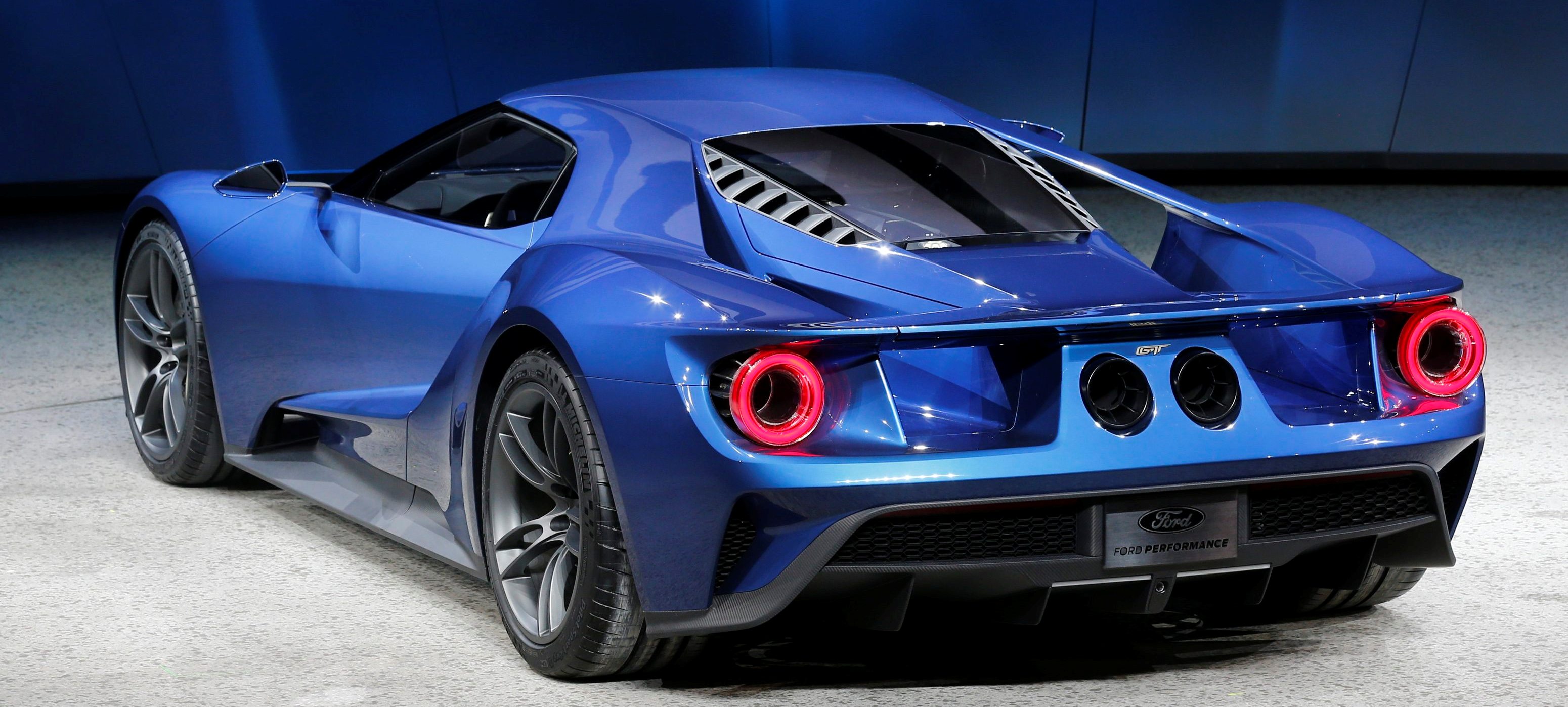
All of the chassis porn is matched by the visual titillation of the GT’s body, the flying buttresses of which manage to disguise what is essentially the shape of a Le Mans prototype racer. The wide front end is reminiscent of the classic Ford GT40, but the rest of the design is fully supercar-modern. The tight, two-seat passenger cell tapers to a point above the two cannon-sized central exhaust outlets, and the rear fenders sit entirely apart from the main fuselage. (Credit the laydown, pushrod suspension for making the channels between the wheels and body possible.)
Unlike last decade’s GT, the doors hinge up and forward and don’t incorporate portions of the roof; they still, however, grant access to a simple, businesslike cabin. A digital gauge cluster is augmented by a central colour touch-screen display with Ford’s just-introduced Sync 3 infotainment setup, while the slim centre tunnel houses the starter button and transmission selector buttons. A pair of paddle shifters sprouts from behind a squircle-shaped steering wheel, and we can’t get over the awesome door-mounted HVAC vents.
The previous GT was amazing and a supercar by every standard, but it was also fairly conventional and done more to pay homage to Ford’s Ferrari-slaying GT40s of the past than to advance the breed. This GT, on the other hand, reads like those original GT40s in that it’s an unmistakable shot across the bows of the world’s preeminent supercar makers. It’s as if Ford’s engineers got punch-drunk on performance after churning out the Shelby GT350 and the new F-150 Raptor, turned to one another and asked, “What’s next?” The answer, of course, was to once again take aim at the big guns from Europe.