Customs Today
  • Home
  • Islamabad
  • Karachi
  • Lahore
  • National
  • Transfers and Postings
  • Chambers & Associations
  • Business
No Result
View All Result
Customs Today
  • Home
  • Islamabad
  • Karachi
  • Lahore
  • National
  • Transfers and Postings
  • Chambers & Associations
  • Business
No Result
View All Result
Customs Today
No Result
View All Result
Home Science & Technology Science

Sea ice in Arctic melts due to warm Atlantic Ocean waters

byCustoms Today Report
21/02/2015
in Science, Science & Technology
Share on FacebookShare on Twitter

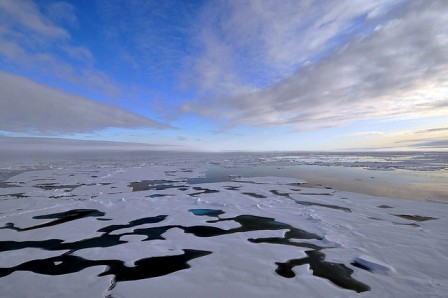
VOLOS: Warm Atlantic Ocean waters are causing sea ice to melt in the Arctic, further contributing to the disappearance of this land mass, according to new research.

A team at Bangor University has realized that warm water in the Atlantic – originating from the Gulf Stream – is flowing deep into the Arctic Ocean and mixing with its colder waters in a way that’s leading to a loss of sea ice extent.


You might also like

Tesla driverless system to use updated radar technology

12/09/2016

Apple to develop its own self-driving technology

10/09/2016

“Our oceans are not made up of one body of water, but contain waters of different temperatures and salinity, lying in different ‘layers’, so the Arctic Ocean is a bit like a jam sandwich, where the ‘bread’ is the cold water layers above and below the ‘jam,’ which is the warm, salty water that enters the Arctic from the Atlantic. Sea-ice floating on the surface of the ocean is insulated from the heat of the Atlantic layer by the ‘top slice’ of cold polar water,” lead author Tom Rippeth explained in a statement.

Until now, studies have focused on how turbulent winds and waves play a role in melting Arctic sea ice, and not so much tidal mixing. Tidal flows around the Arctic Ocean are generally weak, so they were never considered a significant factor in ice melt. But researchers now find that tides are stirring up heat in the Atlantic and bringing it to the Arctic, playing a bigger role than previously thought in sea ice loss.

According to the study, water in the Atlantic is four degrees Celsius (39 degrees Fahrenheit) warmer than the surrounding water – that’s the warmest it’s been in nearly 2,000 years.


Tags: Sea Ice in Arctic

Related Stories

Tesla driverless system to use updated radar technology

byCT Report
12/09/2016

WASHINGTON: Electric carmaker Tesla announced Sunday it was upgrading its Autopilot software to use more advanced radar technology. In a...

Apple to develop its own self-driving technology

byCT Report
10/09/2016

SAN FRANCISCO: Apple may not become an automaker, but it still wants to develop its own self-driving technology. The iPhone-maker's...

NASA spots slowest known magnetar

byCT Report
10/09/2016

WASHINGTON: Astronomers have found evidence of a magnetar - magnetised neutron star - that spins much slower than the slowest...

‘YouTubers’ outshining old-school television

byCT Report
09/08/2016

SAN FRANCISCO: A media revolution is taking place, and most people over 35 years of age aren’t tuned in. Millennial...

Next Post

Two Taiwanese nabbed in Australia for 12kg meth smuggling

  • Terms and Conditions
  • Disclaimer

© 2011 Customs Today -World's first newspaper on customs. Customs Today.

No Result
View All Result
  • Transfers and Postings
  • Latest News
  • Karachi
  • Islamabad
  • Lahore
  • National
  • Chambers & Associations
  • Business
  • About Us

© 2011 Customs Today -World's first newspaper on customs. Customs Today.