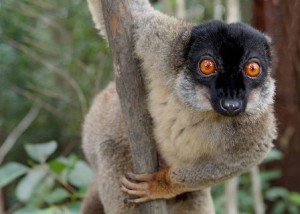
LONDON: Anticipated climate changes in coming decades are likely to leave a lot of Madagascar’s lemurs looking for new places to live.
The habitat of this brown lemur in Madagascar is likely to shrink by half before the end of the century due to climate change, finds a Duke University study. Credit:David Haring, Duke Lemur Center

A new study predicts where the cat-like primates are likely to seek refuge if average temperatures throughout the island rise by 1.1 to 2.6 degrees by 2050, as predicted. Rainfall patterns are expected to change, too.
Changes can already be felt. “Older people in Madagascar talk about how much drier and hotter it is now than when they were children,” said study co-author Anne Yoder, director of the Duke Lemur Center.
Distant primate cousins to humans, lemurs evolved in Madagascar and are found nowhere else on Earth except in zoos and sanctuaries.
Published in the journal Ecology and Evolution, the study includes maps showing where lemurs are likely to seek refuge as temperatures rise and rainfall patterns change across the 225,000-square-mile island over the next 65 years.
The researchers predict that lemurs are likely to be on the move in search of new sources of the leaves and fruit they rely on for food. Fifty-seven of the roughly 100 known lemur species were included in the analysis.
Some lemurs, like crowned sifakas, could fare relatively well. They and eight other species studied are predicted to benefit from changing climate by gaining an average of 80 percent additional territory.
For a quarter of the species studied, ranges are predicted to stay the same size.
But the majority of lemur species — sixty percent — could lose considerable amounts of suitable habitat before the end of the century due to climate change alone. Their habitats are predicted to shrink by hundreds of kilometers in some cases, and by nearly 70 percent on average.