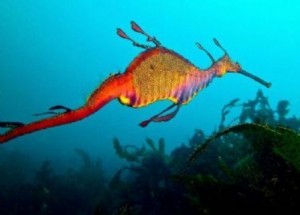


MEXICO: Scientists identify a new species of seadragon after analysing samples from a vivid red specimen discovered in Western Australia. Josefin Stiller, a marine biologist at Scripps Institution in California, led research that first uncovered the ruby seadragon which is believed to live in in dark waters beyond normal scuba diving depth.
Do you want to mee with Ruby, the seadragon that until recently no one knew existed.
A bright red, black-eyed bony beauty, it is only the third species of these peculiar Australian marine creatures ever discovered.
It is a sign of how much more there may be to find in shallow and deeper waters of Australia.
All the time, it was drifting right under scientists’ noses.
The ruby seadragon is believed to live in dark waters beyond normal scuba diving depth, and so escaped attention, unlike its relatives, the leafy and weedy seadragons.
Josefin Stiller, a marine biologist at Scripps Institution in California, led research that first uncovered the ruby seadragon, and described it as a new species of “mesmerising beauty” in the journal Royal Society Open Science.
The discovery of the first new seadragon species in 150 years was “highly unexpected,” Ms Stiller said.
Teasing out the genetics of the two better-known species, she was sent a tissue sample from a Western Australian Museum specimen, thought to be a common seadragon, but found to have clearly different DNA.
Ms Stiller, her Scripps colleague Greg Rouse, and the Western Australian Museum’s Nerida Wilson then checked on the actual specimen, which had been trawled off the Recherche Archipelago in WA in 2007.
It was a male, brooding young, as male seahorses do, about 24 centimetres long and still a vivid red when it was photographed on the research ship.

Karachi Port sets 138-year cargo handling record
KARACHI: Pakistan's maritime sector has achieved a major milestone as Karachi Port set a new record in its 138-year history...