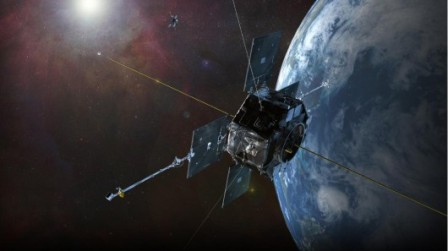
LONDON: Back in October 2013, two NASA probes were in the perfect position to observe a solar wave as it hit Earth’s magnetic field, gathering data on the event. That data has now been analyzed by teams of scientists at MIT’s Haystack Observatory and the University of Colorado, revealing the process by which harmful, high-speed particles are generated in Earth’s radiation belts.
The data was collected by NASA’s Van Allen Probes – a pair of spacecraft that orbit within the radiation belts located inside the Earth’s magnetic field, known as the Van Allen radiation belts. A primary goal of the probes’ mission is to answer the question of exactly how the belts give rise to high-speed particles that move around the Earth at 1,000 km/h (6,214 mph), causing damage to satellite and spacecraft electronics.
The two probes, which maintain the same orbit around the Earth, were in the perfect position to record the effects of the shockwave when it struck on October 8, 2013. The first probe was facing the sun at the time of the solar wave, observing the radiation belts just before the shockwave encountered Earth’s magnetic field, while the second, which follows behind by one hour, recorded the aftermath of the event.
The data revealed that when the solar shockwave bounced off Earth’s magnetic field, it generated a magnetized sound wave – known as a magnetosonic pulse – in the opposite direction. Within minutes, the sound wave propagated to the far side of the planet, moving though the radiation belts, sweeping up low-energy particles and accelerating them to energies of 3 to 4 million electronvolts. Known as ultrarelativistic electrons, these particles can pass through satellites and other spacecraft, causing significant damage.
In just one minute, the wave increased the number of such particles in existence by a factor of ten. It was found that particles are more likely to gain energy from the wave if their velocity matches that of the magnetosonic pulse, something the team refers to as “drift resonance.” The longer a particle interacts with the pulse, the more it is accelerated.
The study represents first full observation and analysis of the effects of solar shockwaves on Earth’s radiation belts, but there’s still much to learn. “This was a relatively small shock,” said observatory director John Foster. “We know they can be much, much bigger … This could be the tip of the iceberg in how we understand radiation belt physics.”