

Customs Today
  • Home
  • Islamabad
  • Karachi
  • Lahore
  • National
  • Transfers and Postings
  • Chambers & Associations
  • Business
No Result
View All Result
Customs Today
  • Home
  • Islamabad
  • Karachi
  • Lahore
  • National
  • Transfers and Postings
  • Chambers & Associations
  • Business
No Result
View All Result
Customs Today
No Result
View All Result
Home Science & Technology Science

NASA scientists reproduce building blocks of life non-biologically in lab

byCustoms Today Report
07/03/2015
in Science, Science & Technology
Share on FacebookShare on Twitter

You might also like

Tesla driverless system to use updated radar technology

12/09/2016

Apple to develop its own self-driving technology

10/09/2016

WASHINGTON: Scientists over at NASA’s Ames Research Center in Moffett Field, California have reproduced non-biologically the three basic components of life found in both DNA and RAN – uracil, cytosine, and thymine – in lab.
“We have demonstrated for the first time that we can make uracil, cytosine, and thymine, all three components of RNA and DNA, non-biologically in a laboratory under conditions found in space,” said Michel Nuevo, research scientist at NASA’s Ames Research Center, Moffett Field, California.
Nuevo added that their processes can be used to make several fundamental building blocks used by living organisms on Earth by simulating conditions in space in a lab.
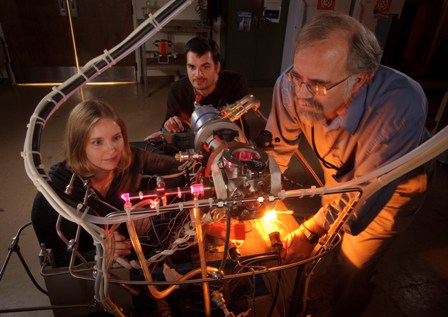
For their experiment scientists deposited an ice sample containing pyrimidine on a cold substrate in a chamber with space-like conditions such as very high vacuum, extremely low temperatures, and harsh radiation and irradiated the sample with high-energy ultraviolet (UV) photons from a hydrogen lamp. Researchers discovered that such an arrangement produces these essential ingredients of life including uracil, cytosine, and thymine.
Pyrimidine is a ring-shaped molecule made up of carbon and nitrogen and is the central structure for uracil, cytosine, and thymine, which are all three part of a genetic code found in ribonucleic (RNA) and deoxyribonucleic acids (DNA).
The bombarding photons break chemical bonds in the ices and break down the ice’s molecules into fragments that then recombine to form new compounds, such as uracil, cytosine, and thymine.

Related Stories

Tesla driverless system to use updated radar technology

byCT Report
12/09/2016

WASHINGTON: Electric carmaker Tesla announced Sunday it was upgrading its Autopilot software to use more advanced radar technology. In a...

Apple to develop its own self-driving technology

byCT Report
10/09/2016

SAN FRANCISCO: Apple may not become an automaker, but it still wants to develop its own self-driving technology. The iPhone-maker's...

NASA spots slowest known magnetar

byCT Report
10/09/2016

WASHINGTON: Astronomers have found evidence of a magnetar - magnetised neutron star - that spins much slower than the slowest...

‘YouTubers’ outshining old-school television

byCT Report
09/08/2016

SAN FRANCISCO: A media revolution is taking place, and most people over 35 years of age aren’t tuned in. Millennial...

Next Post

Sony Xperia Z4 not waterproof smartphone but targets HTC One M9, Samsung Galaxy S6

  • Terms and Conditions
  • Disclaimer

© 2011 Customs Today -World's first newspaper on customs. Customs Today.

No Result
View All Result
  • Transfers and Postings
  • Latest News
  • Karachi
  • Islamabad
  • Lahore
  • National
  • Chambers & Associations
  • Business
  • About Us

© 2011 Customs Today -World's first newspaper on customs. Customs Today.