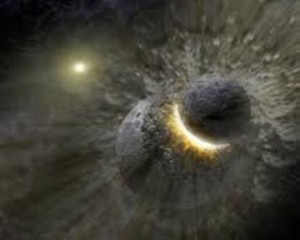
FRANCE: We already know that Earth’s formation would have been a rough time for the planet — asteroids and even other young planets from the Solar System’s birth slammed into our planet repeatedly. Now, though, researchers suspect that that bombardment may have included mists of molten iron and other metals raining down from the sky. The finding might also explain why the Moon and the Earth have such different chemistry, according to Simon Redfern, at the Conversation.
About 4.6 billion years ago, the swirls of hot dust and gas around our Sun finally coalesced and collided; the Earth and other planets were born. Or so we think. Those events happened so long ago that piecing them together is tricky. For example, the Moon may have come from a collision between young Earth and a Mars-sized protoplanet, whose dense elements joined Earth’s blisteringly-hot iron core. But there are other theories too. Another mystery: why is the Earth’s composition so different from the Moon’s?
The Moon has less iron and precious metal than the Earth does, and the Earth really has too many of those too close to the surface. As the core formed, it should have “sucked” all the heavier elements out of the mantle. But researchers’ measurements show a lot more iron, gold and other metals in the mantel than we’d expect. The new research solves that problem: Instead of just modeling possibilities, a team of researchers used the Sandia National Laboratory’s Z machine—which can generate enormous pulses of electromagnetic radiation—to figure out what might have happened to iron-bearing asteroids that bombarded early Earth.
They found that when the planet was super hot, like it was during formation, iron would have vaporized easily on impact.
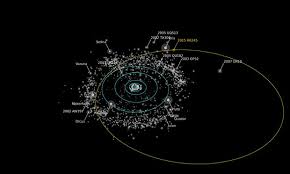
Astronomers discover distant dwarf planet beyond Neptune
LONDON: A dwarf planet half the size of Britain has been found tumbling through space in the most distant reaches...