Customs Today
  • Home
  • Islamabad
  • Karachi
  • Lahore
  • National
  • Transfers and Postings
  • Chambers & Associations
  • Business
No Result
View All Result
Customs Today
  • Home
  • Islamabad
  • Karachi
  • Lahore
  • National
  • Transfers and Postings
  • Chambers & Associations
  • Business
No Result
View All Result
Customs Today
No Result
View All Result
Home Science & Technology Science

New Species ‘Living Dinosaur’ moth discovered in Australia 1st time since 1970s

byCustoms Today Report
09/03/2015
in Science, Science & Technology
Share on FacebookShare on Twitter

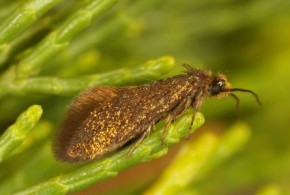
PERTH: Researchers discovered a new family of primitive moths for the first time since the 1970s, and the elusive winged insects could reveal evolutionary secrets.

The “living dinosaurs,” dubbed Aenigmatinea glatzella, have stunning purple and gold wings and reside on Southern Cypress-pine trees (Callitris gracilis) in Australia, specifically on Kangaroo Island, CSIRO reported. The adult moths live for only about one day after emerging from their cocoons; in this time they manage to find time to mate and for the females to lay eggs.


You might also like

Tesla driverless system to use updated radar technology

12/09/2016

Apple to develop its own self-driving technology

10/09/2016

A research team studied the moth’s appearance and analyzed its DNA, and the findings revealed the insect’s ancient lineage and evolutionary history was much more complex than they had anticipated.

“While the discovery of this new moth strengthens the evolutionary relationships between other primitive moth families, it also suggests that tongues evolved in moths and butterflies more than once,” Dr Edwards, an Honorary Fellow with CSIRO’s Australian National Insect Collection, said. “Our fauna is so exciting we can still find new primitive species. Australia is so rich in moths that vast numbers still remain to be discovered.”

Australia is believed to house at least 22,000 species of moths and butterflies that are still yet to be named by scientists, and in the future the researchers hope to make more findings such as this one, and gain even more insight into the evolution of moths and butterflies.

“CSIRO’s Australian National Insect Collection is the world’s largest collection of Australian insects and related groups. It is a nationally and internationally significant research resource that contributes to our understanding of biodiversity, and supports research in evolutionary biology, ecology, biosecurity and natural resource management,” the researchers noted.


Related Stories

Tesla driverless system to use updated radar technology

byCT Report
12/09/2016

WASHINGTON: Electric carmaker Tesla announced Sunday it was upgrading its Autopilot software to use more advanced radar technology. In a...

Apple to develop its own self-driving technology

byCT Report
10/09/2016

SAN FRANCISCO: Apple may not become an automaker, but it still wants to develop its own self-driving technology. The iPhone-maker's...

NASA spots slowest known magnetar

byCT Report
10/09/2016

WASHINGTON: Astronomers have found evidence of a magnetar - magnetised neutron star - that spins much slower than the slowest...

‘YouTubers’ outshining old-school television

byCT Report
09/08/2016

SAN FRANCISCO: A media revolution is taking place, and most people over 35 years of age aren’t tuned in. Millennial...

Next Post

Shanghai stocks down 0.22% to 3,241.19 points

  • Terms and Conditions
  • Disclaimer

© 2011 Customs Today -World's first newspaper on customs. Customs Today.

No Result
View All Result
  • Transfers and Postings
  • Latest News
  • Karachi
  • Islamabad
  • Lahore
  • National
  • Chambers & Associations
  • Business
  • About Us

© 2011 Customs Today -World's first newspaper on customs. Customs Today.