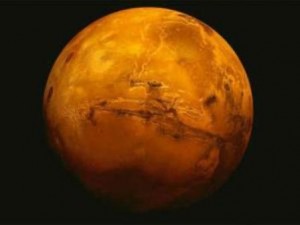


HONG KONG: In Edgar Rice Burroughs’s Barsoom novels, Earthman John Carter’s adventures took place on the dry beds of Mar’s ancient oceans. Now NASA scientist’s say that may not be so far fetched. Though they haven’t found signs of any thoats, they have estimated that Mars may once have had enough water to form a vast ocean surrounding its north pole of which only plains remain.
Today, Mars is drier than the Atacama Desert and what little water that remains is either locked in the polar ice caps or deposited as permafrost deep below ground. However, by using Earthbound infrared telescopes to measure hydrogen isotopes in the Martian atmosphere, scientists have been able to calculate how much water the Red Planet may have once harbored in its ancient past.
According to NASA, some 4.3 billion years ago, Mars may have been a much wetter place with over 20 million km3 (5 million mi3) of water. Scientists believe that this water wasn’t spread evenly over the planet, but collected in the northern hemisphere’s Northern Plains to form an ocean covering 19 percent of the Martian surface and plunging up to a mile (1.6 km) deep in places.
This would make for a body with more water than Earth’s Arctic Ocean and covering more of the planet than the Atlantic does on Earth. It’s also a volume of water 6.5 times greater than what is in the Martian ice caps today, which indicates a massive loss of water into space after Mars started drying up about 3.7 billion years ago.
The estimate was based on observations conducted by the European Southern Observatory’s Very Large Telescope in Chile, and the W.M. Keck Observatory and NASA Infrared Telescope Facility in Hawaii. Using hydrogen isotope measurements from an ancient meteorite that was blasted away from Mars 4.5 billion years ago as a baseline, the astronomers took six years (three Martian years) worth of measurements of the water molecules in the Martian atmosphere with a particular emphasis on building up planet-wide maps of the ratios of different hydrogen isotopes.

Karachi Port sets 138-year cargo handling record
KARACHI: Pakistan's maritime sector has achieved a major milestone as Karachi Port set a new record in its 138-year history...