BRENT: Astronomers have discovered a star racing at an incredible pace of 2.6 million miles an hour (4.2 million kilometers an hour), making it the fastest moving star discovered thus far. It’s so fast that it should exit our galaxy and turn into an intergalactic rogue. It doesn’t stop here. Such celestial oddities are believed to be spurred in motion by the extreme gravitational tugs found in the vicinity of super-massive black holes, such as the one found at the core of the Milky Way. The new found road runner, however, was most likely flung outward by a Type Ia supernova, one of the most powerful and brightest bursts of energy in the universe. Little is know about such stellar explosions, and the hypervelocity star might submit some valuable clues.
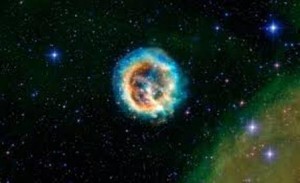
A Type Ia supernovae is basically an exploding star that briefly become as bright as an entire galaxy of billions of stars. There are three scenarios which theoretically explain their formation. First, when two white dwarfs collide; a white dwarf is the leftover of a red star after it swelled out of existence. Secondly, when a white dwarf absorbs material from a twin star until it reaches a critical mass—1.4 times that of the Sun—and explodes. A third possible scenario, never experimentally proven thus far, is when a white dwarf ‘eats up’the helium of its binary companion to quickly fuel a thermonuclear explosion. Such an explosion would theoretically fling the companion out of orbit and well into the galaxy at large velocity.
Researchers , led by Stephan Geier of the European Southern Observatory, found the star – classified as a hot subdwarf named US 708 – while looking for evidence of such a supernova formation. The team used the Echellette Spectrograph and Imager on the Keck II telescope to measure its distance and radial velocity component, which describes how fast it was moving away from Earth. By comparing images taken at various times, the astronomers calculated US 708 must be moving at a whooping 746 miles (1,200 kilometers) per second relative to Earth. At this velocity, it should exit the Milky Way in about 25 million years, according to the paper published in Science.
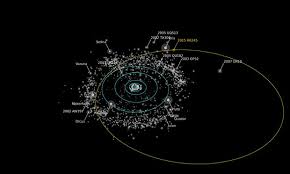
Astronomers discover distant dwarf planet beyond Neptune
LONDON: A dwarf planet half the size of Britain has been found tumbling through space in the most distant reaches...