
Customs Today
  • Home
  • Islamabad
  • Karachi
  • Lahore
  • National
  • Transfers and Postings
  • Chambers & Associations
  • Business
No Result
View All Result
Customs Today
  • Home
  • Islamabad
  • Karachi
  • Lahore
  • National
  • Transfers and Postings
  • Chambers & Associations
  • Business
No Result
View All Result
Customs Today
No Result
View All Result
Home Science & Technology Science

Scientists use 3D scanning techniques for skull reconstruction of tetrapod from 360m yrs ago

byCustoms Today Report
13/03/2015
in Science, Science & Technology
Share on FacebookShare on Twitter

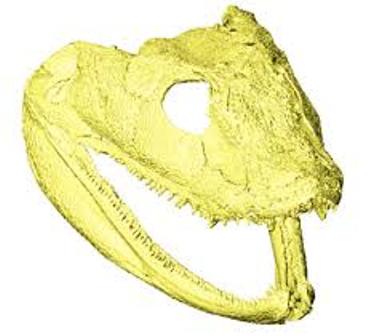
LONDON: X-rays on the skull of a tetrapod which lived 360 million years ago show that the “crucial” species would have seized prey with its jaw and had a longer head than suspected, according to scientists in Bristol and Cambridge carrying out the first 3D reconstruction of the four-footed ancestor of land vertebrates.

Experts are likening the tetrapod to evolved crocodiles after scanning bones deep within the skull of a specimen with the help of complex software. Bones and teeth were separated and cracks were repaired in the skull, allowing scientists to conclude that the Acanthostega used large front teeth and a hook-shaped lower jaw to feed on other creatures.
“Because early tetrapods skulls are often ‘pancaked’ during the fossilization process, these animals are usually reconstructed having very flat heads,” said Dr Laura Porro, the lead author on the study.


You might also like

Tesla driverless system to use updated radar technology

12/09/2016

Apple to develop its own self-driving technology

10/09/2016

“Our new reconstruction suggests the skull of Acanthostega was taller and somewhat narrower than previously interpreted – more similar to the skull of a modern crocodile.”

Researchers now hope to use their methods on more flattened fossils derived from the earliest tetrapods, explaining how some of the first animals to roam land adapted to the challenges they faced.


Tags: 3D scanning techniques for skull reconstructionBristol and Cambridgescanning techniquesScientists use 3DScientists use 3D scanning techniquesskull reconstruction of tetrapod from 360m yrs ago

Related Stories

Tesla driverless system to use updated radar technology

byCT Report
12/09/2016

WASHINGTON: Electric carmaker Tesla announced Sunday it was upgrading its Autopilot software to use more advanced radar technology. In a...

Apple to develop its own self-driving technology

byCT Report
10/09/2016

SAN FRANCISCO: Apple may not become an automaker, but it still wants to develop its own self-driving technology. The iPhone-maker's...

NASA spots slowest known magnetar

byCT Report
10/09/2016

WASHINGTON: Astronomers have found evidence of a magnetar - magnetised neutron star - that spins much slower than the slowest...

‘YouTubers’ outshining old-school television

byCT Report
09/08/2016

SAN FRANCISCO: A media revolution is taking place, and most people over 35 years of age aren’t tuned in. Millennial...

Next Post

2.118m vehicles sold in 2014: BMW witnesses another successful year as revenues up 5.7% to $85b

  • Terms and Conditions
  • Disclaimer

© 2011 Customs Today -World's first newspaper on customs. Customs Today.

No Result
View All Result
  • Transfers and Postings
  • Latest News
  • Karachi
  • Islamabad
  • Lahore
  • National
  • Chambers & Associations
  • Business
  • About Us

© 2011 Customs Today -World's first newspaper on customs. Customs Today.