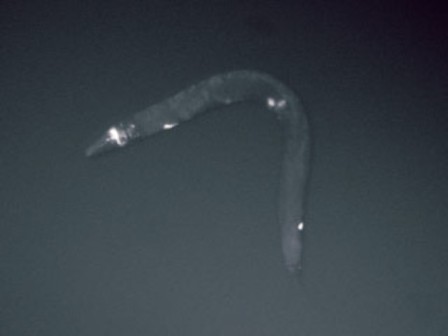
NEW YORK: The study was carried out by scientists at Rockefeller University in New York. They found roundworms would sometimes ‘think’ for themselves. All the neurons within this microscopic roundworm are highlighted, with the large cluster at one end representing the brain
The research was carried out by scientists from the Rockefeller University in New York who studied the brain of the microscopic roundworm Caenorhabditis elegans.


Its 302 neurons and 7,000 synapses are comparatively tiny compared to the 86 billion neurons and 100 trillion synapses in a human brain.
But it is still useful to address tricky neurological questions that would be nearly impossible to broach in our own brains.
They found that, if offered a ‘delicious’ smell, the roundworm will usually stop its wandering to investigate the source – but sometimes it won’t.