
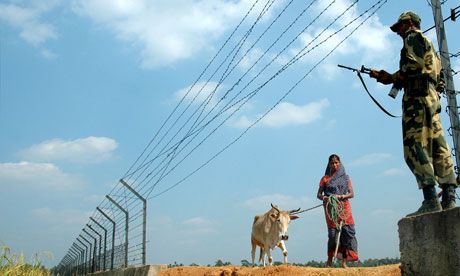
DHAKA: Bangladesh Security Force (BSF) has decided to be careful while tackling cattle smuggling at the India-Bangladesh border that appears to have bolstered the criminals who are now more brave and violent too.
It is estimated at Rs.5,000 to 10,000 crore, cattle smuggling is a flourishing business in this area and India’s Border Security Force is increasingly facing physical attacks on its men.


BSF routinely seizes cattle headed for Bangladesh and arrests smugglers in West Bengal but that is not making any noticeable dent on the business. The “traders”, as the smugglers are called in Bangladesh, resort to innovative ways to take away Indian cows across the border where they are in big demand for their beef and hide.
India and Bangladesh share a 4,096-km winding border. A part of this is fenced but much of it is porous and riverine. With nearly 500 km of the over 2,000 km border between West Bengal and Bangladesh criss-crossed by rivers, the smugglers are using the rivers more often.
“While cattle export is banned in India, the trade is legal in Bangladesh,” Deputy Commandant Manoj Kumar of the BSF’s 144th Battalion told IANS here. “Smuggled cattle become legal in Bangladesh if it is shown the animal was found unclaimed and roaming near the border,” Kumar added.
There is a huge demand for beef in Muslim-majority Bangladesh. The animal also contributes to leather and ceramic industries in a major way.
“The sheer economic interests involved make the smugglers go all out, no matter how hard we try to stop them,” a BSF officer told IANS.
Bought all the way from states like Rajasthan, Haryana, Punjab and Bihar, the cattle mostly make their way into Bangladesh through Malda, Murshidabad and North 24 Parganas districts.
The smugglers, after sneaking into West Bengal, are known to inject cows with drugs that make them restless, compelling them to make a mad dash towards the porous border.
Where the boundary is fenced, the criminals use makeshift wooden cranes to simply lift the animals and hurl them across the border.
It was in 2011, after a row with Bangladesh, that the Indian government told the BSF to avoid firing at the smugglers so that innocent Bangladeshis were not killed.
Emboldened by the BSF’s strategy to use lethal weapons only as a last resort, cattle smuggling has become increasingly violent.
Smugglers frequently cut the fence. From 279 breachings in 2011, it rose to 561 in 2012, 412 in 2013 and 510 in 2014, said a BSF official. A total of 25 breaches took place in January.
While 99 troopers were injured in 2014, the figure has reached 20 in the current year. A BSF trooper and three Bangladeshi smugglers have been killed in 2015.
“Mostly the smugglers come in hundreds. Although we have INSAS rifles, we can’t use them, making us sitting ducks,” said a BSF source.



