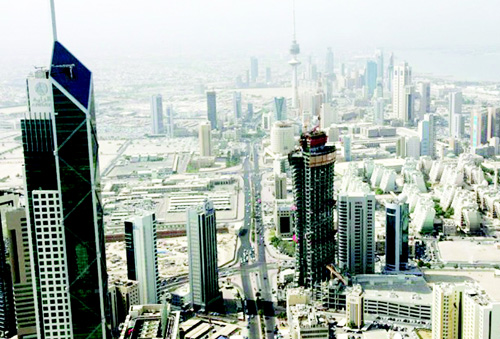
KUWAIT CITY: Kuwait’s sky-high land prices can be made to serve a greater purpose — get a younger generation of Kuwaiti nationals to opt for buying apartments in high-rises than build their own homes at an exorbitant cost. Developers are trying to fast-track such a conversion, with the Tamdeen Group offering two residential towers on freehold for Kuwaiti nationals as part of its $700 million (Dh2.6 billion) Al Khiran development launched here the other day.
“Land value by itself could account for 50-60 per cent of a development’s cost (in established locations within Kuwait City) compared with the 20-30 per cent average in the rest of the Gulf,” said Mohammad Jasem Khalid Al Marzouq, Chairman of Tamdeen Group. “By going vertical [with their projects] and building to a certain quality, developers can offer Kuwaitis an option they did not have before.

“It will be the way to change Kuwait’s skyline to the needs of the market and similar to what is already there in the other Gulf cities.”
It is not just the fact that land values are way too high. As in the major cities of Saudi Arabia, plot availability still remains tightly controlled in Kuwait, which also does much to inflate the asking prices of the land that is released. The easy availability of large greenfield sites and at accessible prices that master-developers in Dubai and Abu Dhabi are offered is still something that Kuwait’s realty market is yet to get accustomed to.
But the times are changing, insists Al Marzouq. “There were certain laws that held up major projects activity for years such as the one on BOT (build-operate-transfer) and, thankfully, with a more receptive parliament in place willing to work with the government, things are changing. Earlier, the masterplanning (for new projects) was based on details that were decades’ old, even 50 years. That meant projects were creating capacity of a scale much smaller than what the market was in need of.
“Now, with the change in the voting mix, there’s an empowered government. Laws have been changed in telecom, there are new ones for infrastructure. In the last two years, the government moves have helped the private sector become more visible.
“When Tamdeen takes up a project and decides on its components, I would like to base it not on the balance that it will have on our future revenues but whether it truly adds value to the country. Tamdeen did make its name as a developer of shopping malls and retail centres, but the need now is for more residential towers and hotels. We will be delivering on that.”
On whether the Tamdeen formula can be made to work outside of Kuwait, Al Marzouq said: “The way I see it would be difficult to compete with some of the biggest master-developers in the other Gulf markets. The simple reason is that they are invariably government-owned and will always have the advantage in their home territory. It would be impossible to go against them in terms of scale.
“Plus, whatever I build outside should be based on the same investment principles we have in Kuwait, such as having ‘dry’ hotels.” But Tamdeen may yet have select exposures outside of its home base. Having just announced Kuwait’s first ‘outlet’ mall through the Al Khiran development, it is studying whether to go ahead and do so in Bahrain as well. Saudi Arabia too is rated a possibility, either on its own or through alliances.
More than anything, the Tamdeen chief believes Kuwait’s moment to seize the spotlight has returned. “For too long, the country has had to deal with other pressing issues, such as threats to the security of the country from Saddam [Hussain],” said Al Marzouq. “Those problems had to be fixed. But now the political climate has started to improve and that is just what’s needed to get everyone involved in creating whatever the country needs, for now and in the future.”
The oil price gyrations do not faze Mohammad Jasem Khalid Al Marzouq, the head of the Tamdeen Group and a Board Member of Kuwait’s Supreme Council for Planning and Development.
“The $600 billion that the Government holds directly or indirectly will limit any fallout on the economy,” said Al Marzouq. “Also, all of Kuwait’s oil reserves are those from land-based fields. Unlike some of the neighbouring oil producers, our sea fields have not been explored at all … and that’s something we can always fall back on in the future if need be.
“Personally, I believe the low oil prices will mean that the Government will call in the private sector to do more. That will always create opportunities for businesses. When oil was above $100 [a barrel], the Government had no need to involve anyone. They were doing everything.”