Customs Today
  • Home
  • Islamabad
  • Karachi
  • Lahore
  • National
  • Transfers and Postings
  • Chambers & Associations
  • Business
No Result
View All Result
Customs Today
  • Home
  • Islamabad
  • Karachi
  • Lahore
  • National
  • Transfers and Postings
  • Chambers & Associations
  • Business
No Result
View All Result
Customs Today
No Result
View All Result
Home Science & Technology Science

Babies of endangered Pinzon giant tortoise born in Galapagos Islands

byCustoms Today Report
16/03/2015
in Science, Science & Technology
Share on FacebookShare on Twitter

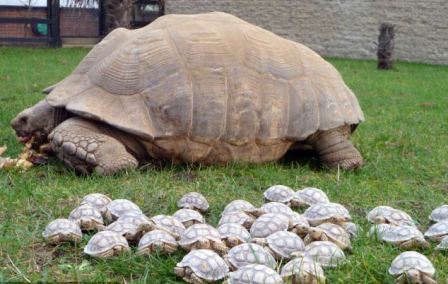
LONDON: For the first time in a century, babies of the endangered Pinzon giant tortoise have been born in the wild in the Galapagos Islands, scientists said.

An expedition in 1970 found only 19 adult tortoises on the archipelago’s Pinzon Island, averaging 70 years old, so scientists removed them to start a captive breeding programme on Santa Cruz island.


You might also like

Tesla driverless system to use updated radar technology

12/09/2016

Apple to develop its own self-driving technology

10/09/2016

The scheme produced juvenile tortoises that were transplanted back to the species’ home island.

Danny Rueda, who is in charge of conservation and restoration of ecosystems in the Galapagos, said that in December six infant Pinzons were found to have been born on the island.

He said there are now 650 juvenile and adult tortoises on Pinzon.

Mr Rueda said the reintroduction of the tortoise was helped by the 2012 campaign to eradicate rats that infested Pinzon and other islands in the archipelago after being introduced long ago by passing ships. The rats prevented the reproduction by tortoises and other species.

“Finding the six baby tortoises tells us that the process of eradicating rats succeeded,” he said.

“We have begun to see that the ecosystem has begun to restore itself” on Pinzon, Mr Rueda added. “It is a process that takes a long time. But the first step is the birth of tortoises in their natural habitat, which a century ago did not happen.”

The Galapagos, an Ecuadorean territory in the Pacific about 620 miles (1,000 kilometres) from the mainland, was declared a World Heritage Site by Unesco in 1978 because of its unique land and marine animals and vegetation. That flora and fauna helped inspire Charles Darwin’s theory of evolution.


Related Stories

Tesla driverless system to use updated radar technology

byCT Report
12/09/2016

WASHINGTON: Electric carmaker Tesla announced Sunday it was upgrading its Autopilot software to use more advanced radar technology. In a...

Apple to develop its own self-driving technology

byCT Report
10/09/2016

SAN FRANCISCO: Apple may not become an automaker, but it still wants to develop its own self-driving technology. The iPhone-maker's...

NASA spots slowest known magnetar

byCT Report
10/09/2016

WASHINGTON: Astronomers have found evidence of a magnetar - magnetised neutron star - that spins much slower than the slowest...

‘YouTubers’ outshining old-school television

byCT Report
09/08/2016

SAN FRANCISCO: A media revolution is taking place, and most people over 35 years of age aren’t tuned in. Millennial...

Next Post

South Africa business confidence index edges higher to 92.8 in February

  • Terms and Conditions
  • Disclaimer

© 2011 Customs Today -World's first newspaper on customs. Customs Today.

No Result
View All Result
  • Transfers and Postings
  • Latest News
  • Karachi
  • Islamabad
  • Lahore
  • National
  • Chambers & Associations
  • Business
  • About Us

© 2011 Customs Today -World's first newspaper on customs. Customs Today.