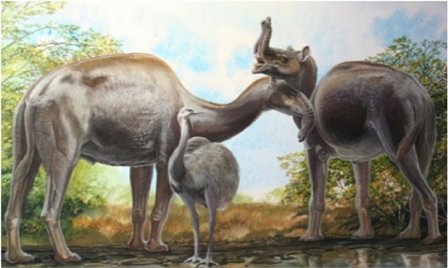


MEXICO: In 1834, Charles Darwin discovered a very strange set of bones as his famous HMS Beagle was surveying the area around Port St. Julian in Patagonia, or what is now Argentina.
At first, Darwin identified the fossils as belonging to a large animal resembling a mastodon. But later, working with anatomist Richard Owen, he discovered that the creature’s vertebrae and other bone fragments were more similar to those of some gigantic camel-like species. Owen named the creature Macrauchenia patachonica.
With legs like a camel, a body like a rodent, and elephant-like facial features, Darwin called the bizarre creature “the strangest animal ever discovered,” according to a report by The Telegraph.
But now, almost 200 years later, scientists using a technique called protein sequencing have revealed that the odd mammal is an ungulate, or hoofed animal, and is closely related to horses.
Co-author of a paper published in the journal Nature, Ross MacPhee, a curator at the American Museum of Natural History’s Department of Mammalogy, told The Telegraph that paleontologists have always found it hard to fit South American ungulates into the mammalian family tree “because anatomically they were these weird mosaics, exhibiting features found in a huge variety of quite unrelated species living all over the place. …With all of these conflicting signals, they couldn’t say whether these ungulates were related to giant rodents, or elephants, or camels—or what have you.”
At first, MacPhee, along with experts from the University of York and the Natural History Museum in London, tried to sequence the ancient creature’s DNA. However, the genetic material had become too degraded.

Karachi Port sets 138-year cargo handling record
KARACHI: Pakistan's maritime sector has achieved a major milestone as Karachi Port set a new record in its 138-year history...