
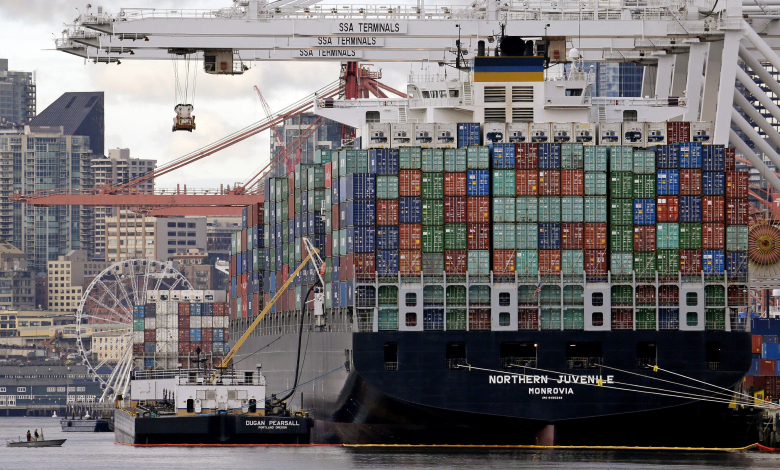
WASHINGTON: The backlog of ships anchored in Puget Sound, 18 ships are still stuck off Southern California, and the entire West Coast has only begun to eliminate the cargo backlog from the recent labor dispute.
But the fight between shippers and the dockworkers union, resolved last month, was only one of the causes of chronic congestion.
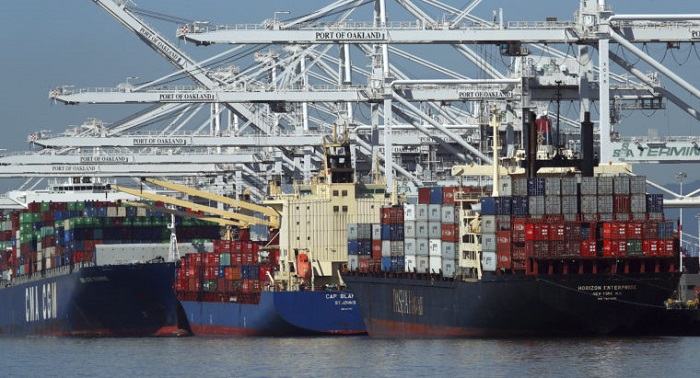

Sweeping changes have upended cargo trade at major U.S. ports. To cut costs, shippers have formed alliances to combine goods from multiple carriers on so-called megaships, some with nearly twice the capacity of traditional commercial vessels. That means each ship takes that much longer to unload.
At the same time, the shipping companies outsourced the management of truck trailers that carry shipping containers around the country. That transition did not go smoothly, creating a logistical nightmare that snarled West Coast ports long before labor talks broke down.
Traditionally, each shipping line had its own terminal at the port and provided its own trailers, allowing containers to be trucked away to warehouses and distribution centers. That gave shipping companies control over much of the supply chain, from the loading of goods in China to distribution via the U.S. highway system.
The arrival of much larger ships, carrying goods from several ocean carriers, means that cargo once confined to a specific terminal can end up anywhere at the port, creating logistical problems for the dockworkers who move the cargo.
In addition, shipping companies in recent years decided to sell off the truck trailers they had traditionally provided at U.S. ports.
The trailers, called chassis at the ports, are a crucial link in global transport. By outsourcing to third-party equipment companies, shipping lines inserted new players into the mix.
The changes meant truckers had to ensure they were using the correct trailers to haul away the goods. With cargo increasingly spread out across terminals — a side-effect of the megaships — the trailers often weren’t where they needed to be.
That sent truckers on hourslong expeditions searching for chassis.
“Something that used to be a given when you came to get a container became such a huge problem,” said Dean McGrath, president of the International Warehouse and Longshore Union (ILWU) Local 23 in Tacoma.
Chassis operators deny that outsourcing was the primary cause of delays.
“Chassis were a part of it, no question about it,” said Keith Lovetro, chief executive of TRAC Intermodal, the nation’s largest supplier of the equipment.
But the complexity brought on by larger ships — combined with longshore workers’ shifts being cut during the last month of the dispute created “the perfect storm of congestion,” Lovetro said.
The Pacific Maritime Association (PMA), which represents shipping companies at the West Coast ports, declined to comment.
Trucking companies have seen delays since the shipping lines outsourced the chassis.
But in the four months of contract talks between the PMA and the ILWU, those issues became more apparent, said Conor Farley with PCC Logistics, a warehouse and trucking company that uses the ports of Seattle and Tacoma.
“It was a vicious cycle,” Farley said. “We had containers on the dock backing up. We didn’t have chassis to put them on, but we couldn’t return the empty containers that were sitting on chassis somewhere else.”
Many port truck drivers are paid by the number of loads they deliver, not the hours they work, so delays cost them money. At one point, delays in Puget Sound moved from hours to days. Backups at Terminal 18 caused one trucker from Portland to be overnighted in Seattle while waiting to drop of a container. The trucker did not want to be identified for fear of retaliation at the terminals.
“You expect to be able to hit the port and then leave,” he said. “If you drop it off in eight hours, it is the same money as 10 to 12 hours, or in that case two days.”
