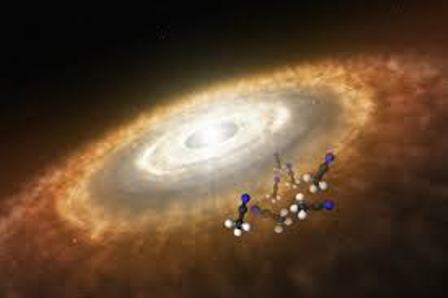


HARROW: Scientists using the Atacama Large Millimeter/submillimeter Array have found a complex carbon-based molecule in a protoplanetary disc around a young star – in quantities enough to fill all of Earth’s oceans – hinting that prebiotic chemistry is indeed universal and not limited to our Solar System.
Methyl cyanide (CH3CN), along with hydrogen cyanide (HCN) were both detected in the cold, outer regions of the nascent disc surrounding MWC 480, a million year old protostar at the heart of the system. These species are of particular interest as molecules such as cyanides contain carbon-nitrogen bonds, pathways that assist in the production of amino acids – the structural elements from which proteins are built.
“From the study of exoplanets, we know the Solar System isn’t unique in its number of planets or abundance of water,” says lead author of the new paper, Karin Öberg, an astronomer with the Harvard-Smithsonian Center for Astrophysics in Cambridge, Massachusetts, USA. “We now have evidence that this same chemistry exists elsewhere in the Universe, in regions that could form solar systems not unlike our own.”

Karachi Port sets 138-year cargo handling record
KARACHI: Pakistan's maritime sector has achieved a major milestone as Karachi Port set a new record in its 138-year history...