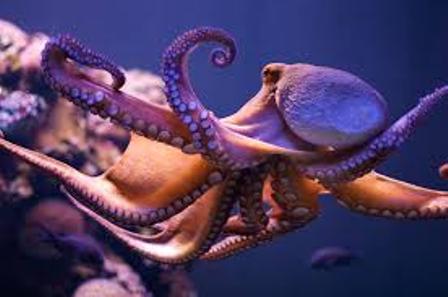
ELY: Researchers have shed light on how the octopuses employ unique strategies to coordinate their bodies and arms while crawling around.
Octopuses have a sophisticated brain in a soft, bilaterally symmetrical body with eight symmetrical and flexible arms. They have excellent vision, a highly developed and large brain and the ability to color camouflage. This makes them excellent hunters.
You might also like


The study, which was conducted by the researchers from the Hebrew University of Jerusalem, and published in the Cell Press journal Current Biology, shows how octopuses move in the water with their tentacles and their movements, which are very unique and elegant. However, researchers added that octopuses’ elegant movement does not have any rhythm.
The researchers conducted a detailed kinematic analysis of octopus arm coordination, showing that they have a unique motor control strategy which the central brain activates, rather than autonomous motor programs in the peripheral nervous system of the arms.
The researchers found that despite having a symmetrical body, the octopuses can crawl in any direction they want relative to its body orientation. The orientation of the body and crawling direction are independently controlled, while there are no apparent rhythmical patterns to the limb coordination.
The researchers showed that the unique maneuverability comes from the radial symmetry of their arms and the simple mechanism by which they create a crawling thrust, which is a simple pushing-by-elongation system. Taken together, the octopus only needs to choose which arms to activate in order to decide the direction of movement.