

FRANCE: There’s no mistaking Jupiter this spring. It pops out even before the end of evening twilight in the high southwestern sky, and is by far the brightest star-like object in that part of the sky.
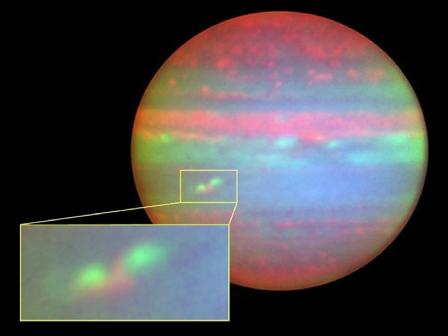
Tonight it’s extra easy to locate, as the waxing gibbous moon will be parked just to the lower left of Jupiter. Even though it’s nearly 475 million miles away, you can look through even a small telescope and see at least some of the cloud bands that circle the gargantuan, 88,000-mile wide planet. These cloud bands are made of sulfur, methane, and other gases. Underneath the cloud bands, Jupiter is basically a giant ball of hydrogen gas with a solid core.
With your telescope, you can also see something that Galileo Galilei saw in the 1600s, something that eventually got him in a lot of trouble. There are little “stars” that show up in a line on either side of Jupiter. These are actually Jupiter’s brightest moons.
As they orbit Jupiter in periods of 2 to 17 days, they constantly change their alignment on either side of the planet. Some nights you don’t see all four of the moons, because one or more of them may be either behind or in front of Jupiter, lost in the backdrop of the planet’s glow.

Karachi Port sets 138-year cargo handling record
KARACHI: Pakistan's maritime sector has achieved a major milestone as Karachi Port set a new record in its 138-year history...