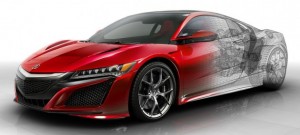
TOKYO: Honda NSX‘s introduced at the SAE 2015 World Congress and Exhibition. The all-new longitudinally-mounted twin-turbo V6 engine has been revealed to displace 3.5 litres.
Featuring both direct and port injection, the 75-degree V6’s dry sump design is said to optimise engine rigidity, lower the centre of gravity and improve lateral performance. Also all-new is the nine-speed dual-clutch gearbox, which incorporates an electric motor that applies torque directly to the crankshaft for more immediate power delivery to the rear wheels.


The NSX has three electric motors one drives the rear wheels and assists in acceleration, braking, and gear changes, while another two power the front wheels, providing torque vectoring. Bring the V6 into the picture and you have a total system output of 550 hp.
The result of over two decades in R&D, the Sport Hybrid Super Handling All-Wheel Drive (SH-AWD) system touts “on rails handling.” The system’s logic has progressed in parallel with the hardware besides relying on feedback and reactions of the vehicle, it responds to driver input via “immediate, precise application of torque at each wheel at any moment.”
The double-wishbone, double-lower control arm front suspension decouples the twin-motor unit torque from the driver’s experience at the steering wheel, resulting in “timeless sports car steering communication.” The steering, by the way, is variable-ratio.
The NSX uses an aluminium-intensive, multi-material space frame that promotes rigidity based on internal data; Honda says the body is by far the most rigid in its competitive set. There’s also ultra-high strength steel and a carbon-fibre floor.
The world’s first application of ablation casting in the automotive industry has also allowed castings in key locations for rigidity, while also supporting the ductility necessary for placement within crumple zones. There’s also an all-new three-dimensionally formed A-pillar made out of ultra-high strength steel, affording good visibility while providing exceptional rigidity.
“For this new NSX development, anything and everything that could offer incredible base rigidity and lightweight design was on the table. We considered an all-aluminium unibody, carbon fibre monocoque and space frame designs and ultimately engineered a multi-material space frame because it offers the lowest weight and best rigidity, precision and hybrid powertrain packaging capability of any design,” said principal engineer and NSX body development leader Shawn Tarr.
What about thermal management? The NSX employs 10 air-cooled heat exchangers to cool the front twin-electric motor unit, rear direct-drive electric motor, V6 engine and gearbox. The V6 engine has three radiators – one centre and two side units for maximum airflow volume and efficiency.
The centre radiator is tilted 25 degrees forward this is the sweet spot between the inherent pressure gradient and low centre of gravity, Honda says. In front of it are the condenser and power drive unit coolers. The twin-motor unit is passively cooled through air in the front motor room and by a heat exchanger mounted in front of the right engine sub-radiator.
The gearbox is cooled by two heat exchangers one in front of the left engine sub-radiator and the other in the engine bay. Meanwhile, twin-intercoolers in the side intakes cool the intake air charge.
Finally, there’s aerodynamics. Six vortices flow at the rear of the NSX, including those creating the highest down force across the rear deck lid. Flowing from below the car and exiting through lower, rear diffuser fins is a critical vortex that further anchors the NSX to the road.
The diffuser fins are in fact not parallel to each other they’re narrower towards the front of the car and wider at the rear. Honda says this creates low pressure and further maximises down force. Enough not to require active aero aids!