Customs Today
  • Home
  • Islamabad
  • Karachi
  • Lahore
  • National
  • Transfers and Postings
  • Chambers & Associations
  • Business
No Result
View All Result
Customs Today
  • Home
  • Islamabad
  • Karachi
  • Lahore
  • National
  • Transfers and Postings
  • Chambers & Associations
  • Business
No Result
View All Result
Customs Today
No Result
View All Result
Home Science & Technology Science

NASA researchers suggest that lasers use to destroy space junks

byCustoms Today Report
02/05/2015
in Science, Science & Technology
Share on FacebookShare on Twitter

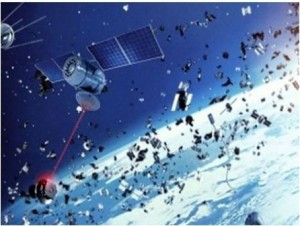
NEW YORK: Approximately 3,000 tons of space junks currently are currently in low Earth orbit, mostly in the area 500 miles (800 km) above the planet’s surface.

To address the potential threat of debris impacting satellites, spacecrafts, and even the International Space Station (ISS), some NASA researchers suggest using lasers to destroy space junk.


You might also like

Tesla driverless system to use updated radar technology

12/09/2016

Apple to develop its own self-driving technology

10/09/2016

The lasers could be fired from a position on the ISS and eventually by a satellite designed specifically for this purpose, according to Toshikazu Ebisuzaki, an astrophysicist and chief scientist at the RIKEN (Rikagaku Kenkyūsho) Computational Astrophysics Laboratory in Wako, Japan.

The amount of space debris is steadily increasing and consists of old satellites, rocket parts, and fragments of prior collisions. Because some of these fragments are traveling very fast, about 22,370 mph (36,000 km/h), even something the size of a screw can do tremendous damage to a satellite.

Impacts by objects smaller than 0.4 inches (1 centimeter) do not present a threat to the ISS, which has protective shielding.

Objects 4 inches (10 cm) or larger can be easily detected from Earth before they do any damage.

The real danger comes from debris fragments  between 0.4 and 4 inches (1 to 10 cm), which are too small for easy detection but can be devastating to a spacecraft or satellite.


Related Stories

Tesla driverless system to use updated radar technology

byCT Report
12/09/2016

WASHINGTON: Electric carmaker Tesla announced Sunday it was upgrading its Autopilot software to use more advanced radar technology. In a...

Apple to develop its own self-driving technology

byCT Report
10/09/2016

SAN FRANCISCO: Apple may not become an automaker, but it still wants to develop its own self-driving technology. The iPhone-maker's...

NASA spots slowest known magnetar

byCT Report
10/09/2016

WASHINGTON: Astronomers have found evidence of a magnetar - magnetised neutron star - that spins much slower than the slowest...

‘YouTubers’ outshining old-school television

byCT Report
09/08/2016

SAN FRANCISCO: A media revolution is taking place, and most people over 35 years of age aren’t tuned in. Millennial...

Next Post

Bats use tiny hairs on their wings to guide their elaborate flights: study

  • Terms and Conditions
  • Disclaimer

© 2011 Customs Today -World's first newspaper on customs. Customs Today.

No Result
View All Result
  • Transfers and Postings
  • Latest News
  • Karachi
  • Islamabad
  • Lahore
  • National
  • Chambers & Associations
  • Business
  • About Us

© 2011 Customs Today -World's first newspaper on customs. Customs Today.