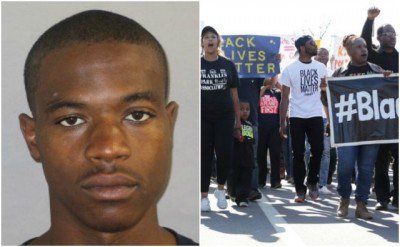
DETROIT: At about 1 p.m. on the afternoon of April 27, a group of local and federal law enforcement officers arrived at Kevin Kellom’s home, a two-story house with beige siding on the outskirts of northwest Detroit.
Some of the officers surrounded the house while others came in and ran upstairs, Kellom said. They had come to serve an arrest warrant on his 20-year-old son, Terrance, who was a suspect in a robbery case. By 1:07 p.m., Terrance Kellom was dead, shot several times by an Immigration and Customs Enforcement (ICE) officer who was part of an interagency fugitive task force.


“I don’t understand why my son was executed,” Kellom said Tuesday during a press conference near his home. “They brought my son downstairs… and then eight shots rang out.”
About 300 Detroit residents and community leaders gathered for a prayer and march later that day, carrying signs that called for justice — not only for Kellom, but also for other people who have been killed by law enforcement officers in recent months.
“As a nation, we need to face this disease, which has plagued this country since its founding: the dehumanization of black bodies and black souls,” said Dawud Walid, a local imam.
Terrance Kellom was the 380th person killed by law enforcement officers in 2015, according to an online database that compiles news reports of instances of use of deadly force. There is no comprehensive national database compiled by law enforcement agencies of police use of deadly force in the United States.
Kellom was killed at the same time Baltimore residents joined massive protests over the April 19 death of Freddie Gray, a 25-year-old African-American man who died from spinal injuries apparently incurred in police custody. And Kellom’s death came just two days after another 20-year-old African-American man was shot by plainclothes officers in Philadelphia after delivering a pizza.
As the national conversation about excessive use of force has focused on local police departments, it has largely overlooked the increasing militarization of federal law enforcement agencies, which has been blamed for fatal results in Detroit and elsewhere.
The Detroit Police Department, which coordinates the interagency Detroit Fugitive Apprehension Team, refuses to say how many officers arrived at Kellom’s house. As is often the case in police killings, accounts from family members differ with those from law enforcement officials.
According to the Detroit Police Department, at some point during the arrest Kellom reached for a hammer, prompting the shooting. His father disagrees, saying, “My son died with clenched fists. He didn’t have a hammer.” The police department said the task force arrived with an arrest warrant signed on April 2; Kellom contends that he only received a warrant on the afternoon his son died, and that it was signed 4:35 p.m. that same day — hours after Terrance was killed.
But for many, the most significant question about Kellom’s death is why ICE agents were at his house in the first place, given that the arrest warrant was not for an immigration-related case.
The answer lies in the rapid and increasing buildup of federal law enforcement agencies since the attacks of Sept. 11, 2001 — especially in cities located near an international border, as is Detroit.
The size and funding of federal law enforcement agencies have ballooned, particularly those related to immigration enforcement and border security. In the mid-1990s, the Immigration and Naturalization Services (INS), the precursor of ICE, received about $1.5 billion in funding and had about 4,000 agents. By 2012, ICE and Customs and Border Protection had an annual budget of $18 billion and more than 80,000 agents combined.
According to Todd Miller, author of “Border Patrol Nation,” an increase in documented cases of brutality and use of deadly force by these federal law enforcement officers has accompanied the “explosive, unprecedented and historic growth” of the agencies.
Most of the instances of deadly force by federal law enforcement agencies involve Customs and Border Protection forces, who killed at least 39 people between 2010 and 2014.
ICE agents are less visible, as they often work in plain clothes and frequently engage in interagency collaboration. In these instances, Miller explained, ICE refers to local police officers as “force multipliers.”
“ICE is like Homeland Security’s secret police,” Miller said.
Kellom’s may be the first documented use of deadly force by an ICE agent in Detroit, although the agency has come under criticism for raids of schools, including an elementary school, in the Southwest neighborhood. Meanwhile, in Texas, ICE officers have been accused of multiple cases of sexual assault of women held inside immigrant detention facilities.
According to ICE spokesperson Khaalid Walls, the agent involved in Monday’s shooting has been placed on administrative leave “consistent with the agency’s Use of Force Policy.” United States Attorney Barbara L. McQuade issued a statement saying the office was “closely monitoring the investigation.”
Meanwhile, for Detroiters and communities across the United States, the shooting has highlighted the less visible but nonetheless increasingly active and pervasive role federal law enforcement agencies have assumed in policing operations.
“In Detroit, there’s been a significant buildup of Homeland Security,” Miller said, adding that the number of Border Patrol agents has ballooned from 40 to 400 over the last decade.
He continued: “This recent shooting and killing, I’d argue, is a natural result of this buildup.”