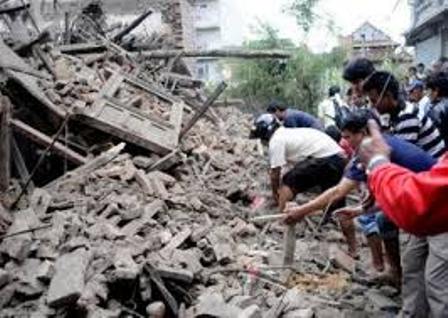


LONDON: The M7.8 (magnitude of 7.8 on Richter scale) earthquake that shook Nepal on April 25, 2015, was anticipated as early as in the early 1990s, says eminent geologist Roger Bilham of the University of Colorado, citing a paper authored by him in 1994.
The rupture front of the quake travelled 90 km from the epicentre at 2.5 km/s towards Kathmandu, arriving at the western outskirts of the valley 35 seconds after the main shock. There, it slowed to 1 km/s as it ruptured 10 km beneath Kathmandu eastwards.
The location of the earthquake is almost identical to the 1833 earthquake. There are reasons to believe that the latest event may be a partial and/ or complete repeat of the 1833 earthquake, says Bilham.
Of great concern to the people of Nepal and north India is the possibility that this could be a foreshock to the anticipated M8 to M8.4 earthquake that historical data suggests the region is capable of sustaining.
Arguments for the observation include the fact that 10 per cent of all great earthquakes have historically been preceded by a major foreshock.
Bilham agrees that the year 1905 M7.8 event in Kangra was not followed by a larger earthquake.

Karachi Port sets 138-year cargo handling record
KARACHI: Pakistan's maritime sector has achieved a major milestone as Karachi Port set a new record in its 138-year history...