
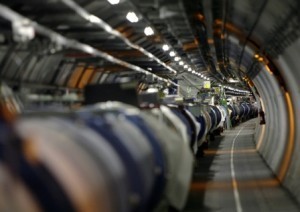


GENEVA: The world’s largest particle smasher resumed colliding protons on Tuesday as it gradually reboots following a two-year upgrade, Europe’s physics lab CERN said.
The low-energy collisions took place in the Large Hadron Collider (LHC) on Tuesday morning, CERN said in a statement.
The protons collided at an energy of 450 gigaelectronvolts (GeV), allowing the scientists to fine tune LHC’s detectors as they prepare to crank the power up to allow collisions at an unprecedented 13 teraelectronvolts (TeV), it said.
Experiments at the collider are aimed at unlocking clues as to how the universe came into existence by studying fundamental particles, the building blocks of all matter, and the forces that control them.
In 2012, the LHC was used to prove the existence of Higgs Boson, the particle that confers mass, earning the 2013 Nobel physics prize for two of the scientists who, back in 1964, had theorised the existence of the so-called “God particle”.
Tuesday’s collisions at the giant lab, housed in a 27-kilometre tunnel straddling the French-Swiss border, are part of preparations for the next experiments to delve into the mysteries of the universe.

Karachi Port sets 138-year cargo handling record
KARACHI: Pakistan's maritime sector has achieved a major milestone as Karachi Port set a new record in its 138-year history...


