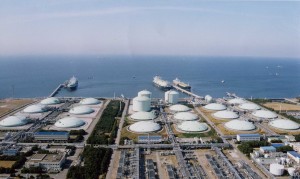
TOKYO: A small Japanese company plans to have final engineering underway this year for a new, medium-sized LNG plant on Cook Inlet in Alaska, a company official said Friday.
Resources Energy Inc. is aiming at niche markets for LNG expected to open in Japan in the next few years as the nation deregulates its gas and electric power industries, according to the company’s Alaska manager, Mary Ann Pease.


The company plans an LNG plant with capacity of 1 million-1.5 million mt/year at Port MacKenzie, a municipal-owned port on upper Cook Inlet, and has acquired rights to a 120-acre site adjacent to the port, Pease said.
REI also hopes to have an application to the US Federal Energy Regulatory Commission filed later this year, she said. Capital costs for REI are now estimated between $1.2 billion and $1.8 billion for the plant, and an additional $1 billion would be needed to purchase the gas for the plant, she said.
REI was formed in 2012 by Hyogo Prefecture and a group of regional technology firms after the 2011 Japan earthquake and tsunami caused the nation’s nuclear power plants to shut, which caused LNG imports to increase and prices to rise. Kyoto Prefecture has since joined Hyogo in the venture.
Pease said the municipal governments want access to their own supply of LNG through REI so as to not be dependent on big LNG importers. They also believe that investing in an LNG project will help them control the price, she said.
Mitsui and Mitsubishi’s investment in the $10 billion Cameron LNG project in Louisiana, announced last August, is similarly an effort to control prices, she said, and is an example of things to come in the LNG business.
The Japan Bank for International Cooperation provided $7 billion in financing for the Cameron LNG project and is also interested in REI’s project, Pease said.
In a presentation to an Alaska business group in April, Eiji Maezawa, REI’s executive vice president and chief operating officer, said deregulation in Japan means municipalities and other industries will be able to participate in the electric power and gas businesses in competition with the major electric power and city gas companies, which will create new market niches.
However, deregulation is also leading to the forming of new alliances in Japan, like a recent joint venture announced between Tokyo Electric and Chubu Electric. By 2025, this alliance could control as much as 45% of Japan’s LNG imports, estimated by then to be 95 million mt/year, Maezawa said.
Similar alliances are expected among Japanese power and city gas utilities, he said. Those combinations of big players could squeeze regional power and gas companies and industries, unless they have their own source of imported LNG, Pease said.
REI hopes to have its project completed and in production by 2019 or 2020, and will at least initially purchase Cook Inlet gas, Pease said. REI commissioned an independent study of potential Cook Inlet gas resources by the Global Energy Consultancy, which estimates proven and probable reserves in the Inlet of 2.7-3.1 Tcf.
REI would require about 55 Bcf/year, or 160 million cu feet/day, or about 35%-40% of the proven and probable reserves, Pease said.
The Global Energy Consultancy study does not include new gas reserves from discoveries made in Cook Inlet by two independent companies because the data has not been made public.
Maezawa said the company is also working on a plan for LNG receiving terminals at two ports on the Japan Sea, with Hyogo Prefecture proposing a port at Himeji, the port for Hirohata, and Kyoto proposing a port at Maizuru. Both would have a capacity to import 500,000 mt.
Terminals in Japan are vulnerable to tsunamis because 95% of them are on the Pacific side, so the new ports on Japan’s western coast are aimed at diversifying the nation’s import infrastructure.
“We’re not competing with the larger Alaska LNG Project [led by North Slope gas producers] because we intend to be in operation several years earlier and will be targeting smaller market opportunities in Japan,” Pease said.
The Alaska LNG Project, for example, would produce 17 million mt/year on average and would be one of the largest LNG producers in the world if it is built. Its size is both an advantage and disadvantage, because costs and risks are large, and assembling enough buyers in the face of stiff competition from US Gulf Coast and other LNG projects is a major challenge, Pease said.
A challenge for REI, however, is that the company has been unable to nail down a Cook Inlet gas supplier, although talks are underway with independent companies that have made recent discoveries in Cook Inlet, Pease said.
REI is important for Cook Inlet, Pease said, because the company will be a major new customer. Independent companies have made new gas discoveries in Cook Inlet but currently have no customers, she said, because Hilcorp Energy, an existing gas producer, has contracts to supply regional utilities into 2018, and ConocoPhillips, which operates a plant on the Kenai Peninsula, also on Cook Inlet, mainly relies on its own gas from the North Cook Inlet field.
“Cook Inlet’s potential for gas will remain just that unless there are additional customers for the gas,” she said.