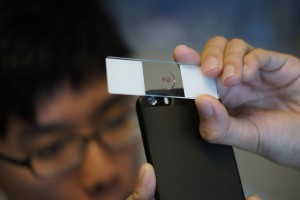
LEED: An optical lens has been designed by the researchers at the University of Houston that can be kept on an low-cost smartphone to make images larger by a magnitude of 120, costing just 3 cents a lens.
Wei-Chuan Shih, assistant professor of electrical and computer engineering at UH, said the lens can work as a microscope, and the cost and comfort of using it — without the assistance of any additional device, it is directly attached to the smartphone camera lens — making it perfect for use for younger students in the classroom.
You might also like


He also said that it could be used for clinical applications, which would allow small or remote clinics to share images with specialists located somewhere else.
According to the paper published in the Journal of Biomedical Optics, Shih and three graduate students illustrate how they make the lenses and inspect the image quality. Yu-Lung Sung, a doctoral candidate, acted as the first author; while others involved in the study include Chia-Hsiung Lee, a former graduate student at UH currently working in the technology industry in Taiwan and Jenn Jeang, who will start graduate school at Liberty University in Virginia this fall.
The lens is made of polymer with the consistency of honey which is also known as polydimethylsiloxane (PDMS), is put exactly on a preheated surface to cure. Sung said that Lens curvature — and hence, magnification — depends on the duration and at what temperature the PDMS is heated. The resulting lenses like the soft contact lens, are flexible, although they are thick and slightly small. “Our lens can transform a smartphone camera into a microscope by simply attaching the lens without any supporting attachments or mechanism,” the researchers wrote. “The strong, yet non-permanent adhesion between PDMS and glass allows the lens to be easily detached after use. An imaging resolution of 1 (micrometer) with an optical magnification of 120X has been achieved.”