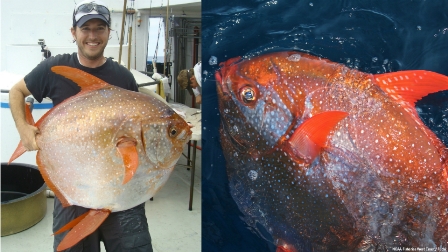


to circulate warm blood, making it the first warm-blooded fish discovered by scientists from the National Oceanic and Atmospheric Administration, or NOAA. The curiosity of NOAA scientists was piqued by the opah’s characteristics.
It includes having a large heart, a lot of muscles, large eyes and spending all of its time in the deepest and coldest places in the ocean, which are the features of active predators that move swiftly, said Heidi Dewar, one of the authors of the NOAA study. But what distinguishes the opah is that while living at those depths, it does not move slowly and waits for its prey to come near as most predatory fish are.
Its warm blood is the result of the opah’s way of swimming, which is by swiftly moving its pectoral fins instead of undulating its body. The movement generates heat and makes the incoming blood in its vessels warm after it has circulated through the opah’s body, explains Nicholas Wegner, the paper’s lead author and a researcher at NOAA, reports the Washington Post.

Karachi Port sets 138-year cargo handling record
KARACHI: Pakistan's maritime sector has achieved a major milestone as Karachi Port set a new record in its 138-year history...