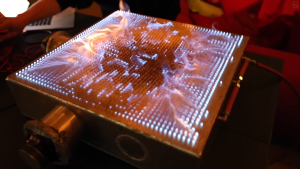
NEW YORK: Researchers in Denmark have created this amazing 2D Ruben’s Tube that lets you see sound with a plane of fire – and Veritasium captured the whole thing on film.
We all know that sound waves exist around us constantly, but we never get a chance to actually see them.Unless, that is, you happen to have a Ruben’s Tube – a hole-ridden pipe filled with flammable gas that, when lit, essentially becomes a row of Bunsen burners. When you play sounds into this tube, the frequency of the sound waves causes more gas to be pushed through some holes, and less through others, causing the wave pattern to be visualised.


Witnessing that is amazing enough (you can see it here), but physicists in Denmark have taken it one step further by creating a 2D Ruben’s Tube – essentially a gas-filled plane with 2,500 holes in it. And when you light it up, it allows you to visualise sound through a whole sheet of bright blue dancing flames.
Back in April, Derek Muller from Veritasium went to Denmark to see what all the fuss was about, and captured this amazing footage of the device in action. And it’s just as stunning as you can imagine.
So what’s going on here? Sound waves form patterns of vibration in the air, with some parts of air having a lot of vibration going on, while others sections don’t have as much. The amount of vibration going on in the air below the holes affects the flow rates of the gas inside the tube or plane, and affects flame height.
The points where there is maximum displacement on the wave are called the anti-nodes, and this is where the flames are coming out on the 2D Ruben’s Plane. The nodes, which are the parts of the wave that cross the midline and remain unchanged, generally don’t have enough pressure to push out a flame.
But this is only the case when sounds are played at high volumes – as the volume drops, the pattern actually changes. And as you can see in the video above, you can hear with your own ears whether you’re standing in an anti-node or node pathway.