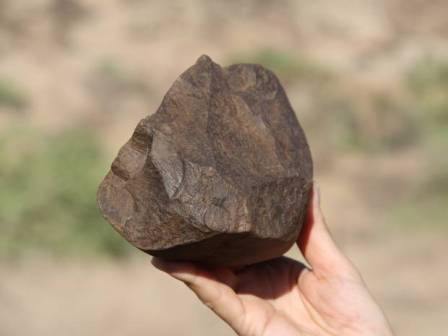


VERIA: For years, conventional thought has held that humans were the first to start using stone tools. In Stanley Kubrick’s classic film “2001: A Space Odyssey” it is the invention of the bone club that sparks the evolution of man. But a recent discovery might prove that both popular thought (and Stanley Kubrick) may have had it wrong, stone tools have been around for a lot longer than the human lineage.
A collection of sharpened shards, currently considered the oldest handmade stone tools yet discovered, has captured the attention of anthropologists and archaeologists around the world. According to a study published by the journal Nature on May 21, the tools prove that human ancestors were capable of shaping stone into blades nearly 3.3 million years ago, beating the previous record holder for oldest stone tool by an overwhelming 700,000 years.
While chimpanzees and other monkeys are known to use basic tools, like rocks to crack open nuts and sticks to fish insects out of the ground, scientists have long thought that it was only members of the direct human lineage, specifically of the genus Homo, that could manufacture their own tools out of stone. The recent discovery has many rethinking how evolutionary and environmental factors affected ancient human ancestors.
The discovery of the tools turned out to be a lucky accident that occurred when a group of archaeologists were driving around near Lake Turkana in Kenya. “We were driving in the dry riverbed and took the left branch instead of the right, and got off course,” Sofia Harmand, lead author on the study, told Live Science. “Essentially, we got lost and ended up in a new area that looked promising. Something was really unique about this place, we could tell that this zone had a lot of hidden areas just waiting to be explored.”

Karachi Port sets 138-year cargo handling record
KARACHI: Pakistan's maritime sector has achieved a major milestone as Karachi Port set a new record in its 138-year history...