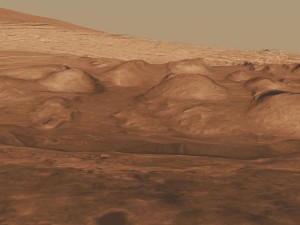
LONDON: Scientists at the European Space Agency (ESA) have discovered what appears to be the remains of a supervolcano on the surface of the planet Mars.
According to reports, the massive caldera measures around 40 by 30 kilometers (25 by 19 miles), with a crater depth of about 1,750 meters (5,741 feet) compared to its surrounding plains. Experts believe the size of the Martian crater is comparable to the supervolcano beneath Yellowstone Park.


The discovery was made as part of the ESA’s ongoing Mars Express mission.
Pictures of the crater were taken in November 2014 using a high-resolution camera placed on board the agency’s satellite.
The Mars Express was focusing on the Siloe Patera feature located on Mars’ Arabia Terra region when the caldera was spotted.
Scientists theorize that Martian craters, such as the one the ESA satellite found, must have been formed around 3 billion years ago after volcanic eruptions spewed large amounts of ash and lava onto the planet’s surface.
The area encompassing Siloe Patera consists of two other craters close to the massive caldera photographed by the Mars Express.