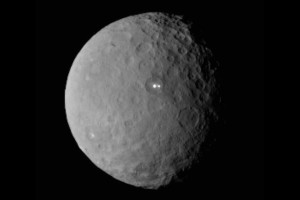
LONDON: NASA has released the most detailed and clear images of the mysterious lights on the dwarf planet Ceres, but unfortunately the agency is no closer to explaining exactly what they are.
The Dawn probe took the image above from a distance of 4,500 miles and they are the most detailed images ever taken of the tiny planet that wasn’t meant to be.
You might also like


The bright spots on Ceres have so far completely stumped scientists working on the mission, who have only offered up speculations about their origin.
“Dawn scientists can now conclude that the intense brightness of these spots is due to the reflection of sunlight by highly reflective material on the surface, possibly ice,” said Christopher Russell, principal investigator for the Dawn mission from the University of California, Los Angeles.
Dawn will move even closer to Ceres on June 6, closing in on the dwarf planet at a distance of 2,700 miles in an effort to discover whether or not volcanic activity is present or not. Scientists continue to hope as Dawn moves closer and closer to largest object in the asteroid belt between Mars and Jupiter, that it will also be able to uncover more of the mystery surrounding these “Alien Lights.”
Dawn was first launched in September 2007 with a mission of studying two of the three known protoplanets in the asteroid belt, Vesta and Ceres. Dawn’s first stop was at Vesta arriving in orbit on July 16, 2011, where it spent 14 months surveying Vesta before leaving for Ceres in late 2012.