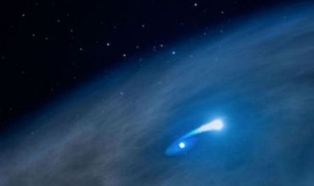


MEXICO: Using Hubble Space Telescope, NASA astronomers have observed strange behavior of a huge star nicknamed it ‘Nasty 1,’ which is aging quickly. Researchers believe that it might be signifying a short transitory phase in the evolution of extremely huge stars.
Nasty 1 was discovered several decades ago and was recognized as a Wolf-Rayet star; it is a quickly evolving star and is massive compared to the sun. Hydrogen-filled outer layers were lost in the star quickly, revealing its super-hot and exceptionally bright helium-burning core.
However, Nasty 1 doesn’t resemble a typical Wolf-Rayet star. The astronomers who used Hubble were looking forward to observe twin lobes of gas flowing from opposite sides of the star, which is probably like those originating from the massive star Eta Carinae; it is a Wolf-Rayet candidate.
In its place, Hubble disclosed a pancake-shaped disk of gas surrounding the star. The huge disk is almost 2 trillion miles wide, and could have formed from an unobserved companion star. On the basis of current estimates, the nebula close to the stars is only a few thousand years old; it is as close as 3,000 light-years from Earth.
According to study leader Jon Mauerhan of the University of California, Berkeley, they are looking forward to observe this disk-like structure since it could be a proof for a Wolf-Rayet star forming from a binary interaction. As per Mauerhan, “There are very few examples in the galaxy of this process in action because this phase is short-lived, perhaps lasting only a hundred thousand years, while the timescale over which a resulting disk is visible could be only ten thousand years or less”.

Karachi Port sets 138-year cargo handling record
KARACHI: Pakistan's maritime sector has achieved a major milestone as Karachi Port set a new record in its 138-year history...