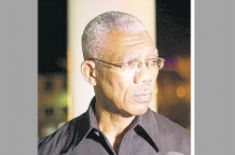
GEORGETOWN: Guyana says it will strengthen its economic relations with the Caribbean Community (Caricom), re-affirming also its interest in maintaining strong relations with Venezuela and Brazil.


“We shall strengthen our economic relations with CARICOM and the Caribbean community. We met the Secretary General of the Community on our first working day. One of the foremost tasks of the Vice-president for Foreign Affairs will be to work tirelessly with every single state of the community to ensure complete compliance with the Treaty of Chaguaramas and the fulfilment of the needs of all the Caribbean people,” President David Granger said.
Speaking at his inauguration as head of state on Tuesday evening, President Granger said that Guyana re-affirmed its relationship “with our neighbours – the Federative Republic of Brazil; the Bolivarian Republic of Venezuela and the Republic of Suriname”, adding “our four neighbouring Republics together have much to contribute to the security and stability”.
He said Guyana possesses the resources needed to be an effective player on the global scene, adding “our land and sea space possess rich mineral resources including bauxite, diamonds, gold, manganese and petroleum.
“Our country is large enough to accommodate all the islands of the Caribbean Community within its boundaries. Our people have their origins in the rich cultures of Asia, Africa and Europe and have blended with the indigenous people of the Americas. We are talented and resourceful. There is no reason for us to be poor. There is enough to satisfy everyone’s need but not everyone’s greed.”
In his address, Granger said his administration would pursue policies aimed at uniting the country and appealed to every Guyanese national to play their part in ensuring the socio-economic development of the country.
“We have assembled to proclaim openly our intention to pursue relentlessly the goal of inclusionary democracy and to reaffirm our respect for our Constitution. The results of the last two elections have made it clear that the majority of the Guyanese people yearn for national unity. They desire an inclusionary democracy. People, increasingly, are abandoning the ‘winner-takes-all’ approach to governance and adopting the collective path to building ‘One Nation.'”
He said the country must now turn its efforts and energy “not towards destroying one another but towards defeating the real enemies of our people – corruption, crime, disease, ignorance and poverty – the four horsemen of the Guyanese Apocalypse.
“The Guyanese people have chosen to inaugurate a government of national unity. We are convinced that working together is the best way to overcome our historic divisions. We are, indeed, more determined than ever to refashion society,” he added.
“We honour the people who want greater inclusion, not exclusion. They want consultation and cooperation between the legislative and executive branches of government, not confrontation. National unity will bring national benefits including the elimination of one-party domination of the government; the enhancement of local, municipal and parliamentary democracy; the enlargement of multi-ethnic space; the elimination of ethnic insecurity; the expansion of economic enterprise; the enrichment of cultural life and the deepening of national consciousness.”
Granger said his administration shall infuse the spirit of ‘inclusionary democracy’ into every municipality, every neighbourhood, every region and into the National Assembly.
“We shall together resume our work, both through the legislative process in the National Assembly and in the country at large, to engage the major sections of society – including other political parties; trade unions; private sector and civil society – to realise our common quest for consensus on a national programme to move the country forward.
“We shall continue to work to harness the talents of a broader constituency, to foster the conditions for social cohesion, to deepen the democratic process and to develop the economy,” Granger said, adding his administration would continue to be committed to ensuring equality for all and to protecting citizens’ fundamental rights.
“We need, most of all, to remain committed to achieving national unity and to building bridges to all communities and groups which are interested in the well-being of our citizens and the progress of our country.”