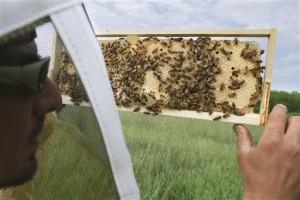
WASHINGTON: If honeybees are busy pollinating large, blooming croplands, farmers wanting to spray toxic pesticides will soon have to buzz off, the Environmental Protection Agency is proposing.
A federal rule proposed Thursday would create temporary pesticide-free zones when certain plants are in bloom around bees that are trucked from farm to farm by professional beekeepers, which are the majority of honeybees in the U.S. The pesticide halt would only happen during the time the flower is in bloom and the bees are there, and only on the property where the bees are working, not neighboring land.


The rule applies to virtually all insecticides, more than 1,000 products involving 76 different chemical compounds, said Jim Jones, EPA’s assistant administrator for chemical safety and pollution prevention. It involves nearly all pesticides, including the much-debated class of pesticides called neonicotinoids, he said.
The idea is “to create greater space between chemicals that are toxic to bees and the bees,” Jones told The Associated Press.
This is part of a new multipart push by the Obama administration to try to reverse dramatic declines in bee populations. A new federal survey found beekeepers lost more than 40 percent of their colonies last year, although they later recovered by dividing surviving hives.
Scientists blame many factors for bee declines: pesticides, parasites, pathogens and poor bee nutrition because of a lack of wild plants that bees use as food. The new rule only deals with the pesticide part; last week, the federal government came up with a plan to create more and varied food for bees on federal land.
The new rule “doesn’t eliminate (pesticide) exposure to honeybees, but it should reduce it,” said University of Illinois entomologist May Berenbaum. “It may not be ideal, but it’s the best news in about 120 years. In concept, in principle, this is a big policy change.”
The EPA proposal doesn’t apply to residential pesticide use, nor home beekeeping. This is just for areas where professional beekeepers haul in their hives. These trucked-around hives now account for about 90 percent of honeybees in the U.S., according to the University of Maryland’s Dennis van Englesdorp.
This method of managed hives is the insect equivalent of handling livestock and is “a fairly intensive process,” said Pennsylvania State University professor Diana Cox-Foster. “I think it’s much more work than raising cows.”