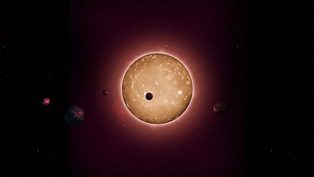


WASHINGTON: The discovery that Earth-sized exoplanets orbit their parent stars in the same way that our planet orbits the sun could help astronomers zero in on planets most likely to harbor extraterrestrial life, scientists say.
Astronomers have long debated whether the more-or-less circular orbits of our solar system’s planets, which keeps them consistently at the same distance from the sun, was the norm for other planets in our universe or whether our solar system was a special case.
In a new study, scientists at MIT and from Denmark’s Aarhus University examined the orbits of 74 exoplanets traveling around 28 distant stars.
“Twenty years ago, we only knew about our solar system, and everything was circular and so everyone expected circular orbits everywhere,” says Vincent Van Eylen, a visiting graduate student in the MIT Department of Physics. “Then we started finding giant exoplanets, and we found suddenly a whole range of eccentricities, so there was an open question about whether this would also hold for smaller planets.”
In their study to be published in the Astrophysical Journal, the researchers report they’ve determined a roughly equidistant circular orbit is, in fact, the norm – at least in systems with planets as small as the Earth.
After creating computer models to generate hypothetical orbits of planets around parent stars with predetermined characteristics – generating them based on the assumption of circular orbits – the researchers turned to NASA’s Kepler space telescope to determine the actual orbital periods of the planets, finding they matched up well with the predicted models, a confirmation that their orbits were essentially circular and regular.

Karachi Port sets 138-year cargo handling record
KARACHI: Pakistan's maritime sector has achieved a major milestone as Karachi Port set a new record in its 138-year history...