Customs Today
  • Home
  • Islamabad
  • Karachi
  • Lahore
  • National
  • Transfers and Postings
  • Chambers & Associations
  • Business
No Result
View All Result
Customs Today
  • Home
  • Islamabad
  • Karachi
  • Lahore
  • National
  • Transfers and Postings
  • Chambers & Associations
  • Business
No Result
View All Result
Customs Today
No Result
View All Result
Home Science & Technology

Stanford engineers develop a computer that operates on water droplets

byCustoms Today Report
16/06/2015
in Science & Technology, Technology
Share on FacebookShare on Twitter

FRANCE: A team of Stanford engineers led by assistant professor of bioengineering Manu Prakesh have created a miniature computer which operates using the physics of water droplets and magnetic fields.

The idea came to Prakash almost a decade ago, when he was a graduate student. Now, using his expertise in manipulating droplet fluid dynamics, he’s managed to create one of the fundamental components of a computer – an operating clock.


You might also like

Tesla driverless system to use updated radar technology

12/09/2016

Apple to develop its own self-driving technology

10/09/2016

So why is a clock so important? And how can you use water droplets to make one? To answer the first question, consider this: in order to function properly, any computer program requires several operations running simultaneously and in a step-by-step manner. If the clock doesn’t work as it should, the operations can run out of sync, and your computing machine is pretty much useless.

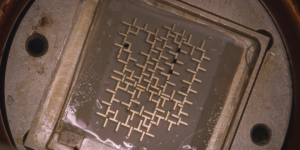
Now, how do you get drops of water to act like a clock? Prakash and his team needed to make the mechanism easy to operate, but also scalable, ensuring a large number of droplets could be manipulated simultaneously in the future. The solution was to use a rotating magnetic field. The researchers first built an array of tiny iron bars on a glass slide (a setup somewhat reminiscent of a Pac-Man maze). A layer of oil was placed above, and a blank glass slide was then laid on top. Finally, individual water droplets infused with tiny magnetic nanoparticles was added to the mechanism. Now all the scientists had to do was place the setup within a magnetic field generated by system of coils, and periodically flip the field. Every time this happens, the polarity of the bars reverses, drawing the droplets into a different, pre-determined configuration. Each of these flips counts as one clock cycle, and every drop advances exactly one step per cycle.


 

Related Stories

Tesla driverless system to use updated radar technology

byCT Report
12/09/2016

WASHINGTON: Electric carmaker Tesla announced Sunday it was upgrading its Autopilot software to use more advanced radar technology. In a...

Apple to develop its own self-driving technology

byCT Report
10/09/2016

SAN FRANCISCO: Apple may not become an automaker, but it still wants to develop its own self-driving technology. The iPhone-maker's...

NASA spots slowest known magnetar

byCT Report
10/09/2016

WASHINGTON: Astronomers have found evidence of a magnetar - magnetised neutron star - that spins much slower than the slowest...

‘YouTubers’ outshining old-school television

byCT Report
09/08/2016

SAN FRANCISCO: A media revolution is taking place, and most people over 35 years of age aren’t tuned in. Millennial...

Next Post

Vietnam’s rice exports hit 2m tones in last 5 months

  • Terms and Conditions
  • Disclaimer

© 2011 Customs Today -World's first newspaper on customs. Customs Today.

No Result
View All Result
  • Transfers and Postings
  • Latest News
  • Karachi
  • Islamabad
  • Lahore
  • National
  • Chambers & Associations
  • Business
  • About Us

© 2011 Customs Today -World's first newspaper on customs. Customs Today.