


Customs Today
  • Home
  • Islamabad
  • Karachi
  • Lahore
  • National
  • Transfers and Postings
  • Chambers & Associations
  • Business
No Result
View All Result
Customs Today
  • Home
  • Islamabad
  • Karachi
  • Lahore
  • National
  • Transfers and Postings
  • Chambers & Associations
  • Business
No Result
View All Result
Customs Today
No Result
View All Result
Home Science & Technology Science

World’s ‘thinnest’ light bulb, made from graphene, debuts

byCustoms Today Report
16/06/2015
in Science, Science & Technology
Share on FacebookShare on Twitter

You might also like

Tesla driverless system to use updated radar technology

12/09/2016

Apple to develop its own self-driving technology

10/09/2016

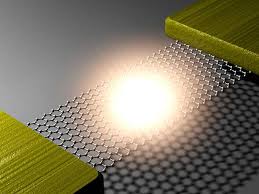
HONG KONG: Scientists have created the world’s smallest light bulb from a one atom-thick layer of graphene, the miracle material that promises to transform everything from smartphones and computers to cars, buildings and satellites.
The ultrathin graphene was turned into a superheated filament – just like the thin wire of an incandescent light bulb – which glowed at a temperature of about 2500C.
The light was so intense it could be seen with the naked eye even though it was on the atomic scale, which meant the high temperatures were confined to a tiny “hot spot” and did not damage the silicon chip on which it was mounted, scientists said.
The discovery could be used as the basis of a new kind of switching device for future optical computers that use pulses of light rather than electricity to process and transmit digital information far faster than conventional silicon chips, they said.
It is the first time that scientists have been able to create a computer chip which has its own visible light source, said James Hone, professor of mechanical engineering at Columbia University in New York, co-author of the study published in the journal Nature Nanotechnology.
“We’ve created what is essentially the world’s thinnest light bulb. This new type of ‘broadband’ light emitter can be integrated into chips and will pave the way towards the realisation of atomically thin, flexible and transparent displays, and graphene-based on-chip optical communications,” Professor Hone said.

Related Stories

Tesla driverless system to use updated radar technology

byCT Report
12/09/2016

WASHINGTON: Electric carmaker Tesla announced Sunday it was upgrading its Autopilot software to use more advanced radar technology. In a...

Apple to develop its own self-driving technology

byCT Report
10/09/2016

SAN FRANCISCO: Apple may not become an automaker, but it still wants to develop its own self-driving technology. The iPhone-maker's...

NASA spots slowest known magnetar

byCT Report
10/09/2016

WASHINGTON: Astronomers have found evidence of a magnetar - magnetised neutron star - that spins much slower than the slowest...

‘YouTubers’ outshining old-school television

byCT Report
09/08/2016

SAN FRANCISCO: A media revolution is taking place, and most people over 35 years of age aren’t tuned in. Millennial...

Next Post

Ireland authorities seize drugs worth £60,000

  • Terms and Conditions
  • Disclaimer

© 2011 Customs Today -World's first newspaper on customs. Customs Today.

No Result
View All Result
  • Transfers and Postings
  • Latest News
  • Karachi
  • Islamabad
  • Lahore
  • National
  • Chambers & Associations
  • Business
  • About Us

© 2011 Customs Today -World's first newspaper on customs. Customs Today.
