

Customs Today
  • Home
  • Islamabad
  • Karachi
  • Lahore
  • National
  • Transfers and Postings
  • Chambers & Associations
  • Business
No Result
View All Result
Customs Today
  • Home
  • Islamabad
  • Karachi
  • Lahore
  • National
  • Transfers and Postings
  • Chambers & Associations
  • Business
No Result
View All Result
Customs Today
No Result
View All Result
Home Science & Technology Science

NASA’s Hubble Telescope detects stratosphere on distant blazing hot exoplanet

byCustoms Today Report
18/06/2015
in Science, Science & Technology
Share on FacebookShare on Twitter

You might also like

Tesla driverless system to use updated radar technology

12/09/2016

Apple to develop its own self-driving technology

10/09/2016

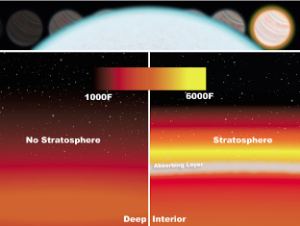
NEW YORK: Stratosphere has been discovered on a distant blazing-hot exoplanet dubbed WASP-33b by NASA’s Hubble Space Telescope – a discovery that scientists claim will enable them to learn more about the composition of a planet and how it formed.
This discovery was unexpected as scientists were unsure whether such an atmospheric layer would be found in the atmospheres of large, extremely hot planets in other star systems.
Though stratosphere would require a book of its own to describe, here is a little primer. In Earth’s atmosphere, the stratosphere sits above the troposphere — the turbulent, active-weather region that reaches from the ground to the altitude where nearly all clouds top out. In the troposphere, the temperature is warmer at the bottom — ground level — and cools down at higher altitudes.
The stratosphere is just the opposite. In this layer, the temperature increases with altitude, a phenomenon called temperature inversion. On Earth, temperature inversion occurs because ozone in the stratosphere absorbs much of the Sun’s ultraviolet radiation, preventing it from reaching the surface, protecting the biosphere, and therefore warming the stratosphere instead.
Similar temperature inversions occur in the stratospheres of other planets in our solar system, such as Jupiter and Saturn. In these cases, the culprit is a different group of molecules called hydrocarbons. Neither ozone nor hydrocarbons, however, could survive at the high temperatures of most known exoplanets, which are planets outside our solar system. This leads to a debate as to whether stratospheres would exist on them at all.

Related Stories

Tesla driverless system to use updated radar technology

byCT Report
12/09/2016

WASHINGTON: Electric carmaker Tesla announced Sunday it was upgrading its Autopilot software to use more advanced radar technology. In a...

Apple to develop its own self-driving technology

byCT Report
10/09/2016

SAN FRANCISCO: Apple may not become an automaker, but it still wants to develop its own self-driving technology. The iPhone-maker's...

NASA spots slowest known magnetar

byCT Report
10/09/2016

WASHINGTON: Astronomers have found evidence of a magnetar - magnetised neutron star - that spins much slower than the slowest...

‘YouTubers’ outshining old-school television

byCT Report
09/08/2016

SAN FRANCISCO: A media revolution is taking place, and most people over 35 years of age aren’t tuned in. Millennial...

Next Post

Nippon Paint China launches new line of paint for childeren

  • Terms and Conditions
  • Disclaimer

© 2011 Customs Today -World's first newspaper on customs. Customs Today.

No Result
View All Result
  • Transfers and Postings
  • Latest News
  • Karachi
  • Islamabad
  • Lahore
  • National
  • Chambers & Associations
  • Business
  • About Us

© 2011 Customs Today -World's first newspaper on customs. Customs Today.