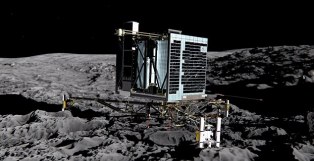
PARIS: European scientists are planning a risky maneuver to get their Rosetta spacecraft closer to the comet it is orbiting, so it can communicate with its robotic lander on the surface and start experiments that could unlock some of the universe’s secrets.
The lander, called Philae, surprised scientists at the weekend by waking up and sending a signal to Earth. Its historic landing on comet 67P/Churyumov-Gerasimenko in November was marred when it bounced into a position too shadowy to power its solar panels.


With the comet moving closer to the sun, scientists hope Philae will be able to generate enough power to resume its pre-programmed experiments.
But in order to receive the data, Rosetta will have to get closer to the comet — to an orbit of about 180 km (112 miles) compared with about 220-240km now.
That is a risky move as the comet approaches the nearest point of its orbit to the sun on Aug. 13 and throws off dust that could block the equipment Rosetta uses to orient itself.
“The comet is a very, very active object at the moment, it’s a bit as if you were to imagine taking your car through a snowstorm,” Elsa Montagnon, Rosetta deputy flight director at the European Space Agency, told a press briefing at the Paris air show on Wednesday.