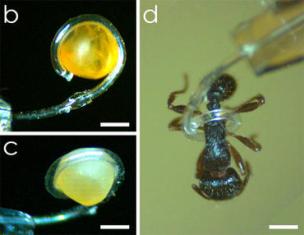


BRENT: Pneumatically powered tiny tentacles enable robots to grasp and handle tiny, delicate objects without damaging them.
How does a robot grasp? Most use grippers modelled on human fingers, but when it comes to manipulating tiny, delicate objects, clumsy fingers and tweezing motions may not be the best way to go, according to researchers at Iowa State University.
Led by Iowa State University associate professor of electrical and computer engineering Jaeyoun Kim, also an associate of the US Department of Energy’s Ames Laboratory, the team has developed a rubbery, microrobotic tentacle that can handle even small insects without causing harm.
“Most robots use two fingers and to pick things up they have to squeeze,” Kim said, “But these tentacles wrap around very gently.”
The tentacles are made from tubes of a clear, flexible silicon compound called polydimethylsiloxane, measuring just eight millimetres long and around 0.2 millimetres wide. To move the tentacle, one end is sealed, and air is pumped in the other end. Combined with asymmetry in the walls of the tubes and a lump of PDMS at the tube’s base, the air pressure causes the tube to curl in a multi-turn spiral motion.

Karachi Port sets 138-year cargo handling record
KARACHI: Pakistan's maritime sector has achieved a major milestone as Karachi Port set a new record in its 138-year history...