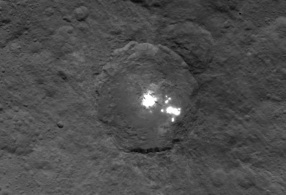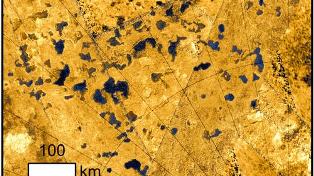


MEXICO: A study using data from the joint NASA and the European Space Agency (ESA) Cassini mission suggests that the Saturn moon Titan’s surface indentation is similar to creation of sinkholes on the Earth.
Apart from the Earth, Titan is the only body in the solar system known to possess surface lakes and seas, which have been observed by the Cassini spacecraft.
The team calculated how long it would take for patches of Titan’s surface to dissolve to create these features.
“We compared the erosion rates of organics in liquid hydrocarbons on Titan with those of carbonate and evaporite minerals in liquid water on Earth,” said Thomas Cornet of the European Space Agency.
“We found that the dissolution process occurs on Titan some 30 times slower than on Earth due to the longer length of Titan’s year and the fact it only rains during Titan summer. Nonetheless, we believe that dissolution is a major cause of landscape evolution on Titan and could be the origin of its lakes,” Cornet said. These are terrestrial landscapes that result from erosion of dissolvable rocks such as limestone and gypsum, in rainfall.
Over time, this leads to features like sinkholes and caves in humid climates and salt-pans. The rate of erosion creating such features depends on factors such as the chemistry of the rocks, the rainfall rate and temperature. While all of these aspects differ between Titan and Earth, researchers think the underlying process may be similar.
“By comparing Titan’s features with that of Earth and applying a few simple calculations, we have found similar land-shaping processes that could be operating under very different climate and chemical regimes,” said Nicolas Altobelli, ESA’s Cassini project scientist.

Karachi Port sets 138-year cargo handling record
KARACHI: Pakistan's maritime sector has achieved a major milestone as Karachi Port set a new record in its 138-year history...